Did you know that both the largest and the smallest steam locomotives operated by British Railways were built by Beyer Peacock, Gorton?
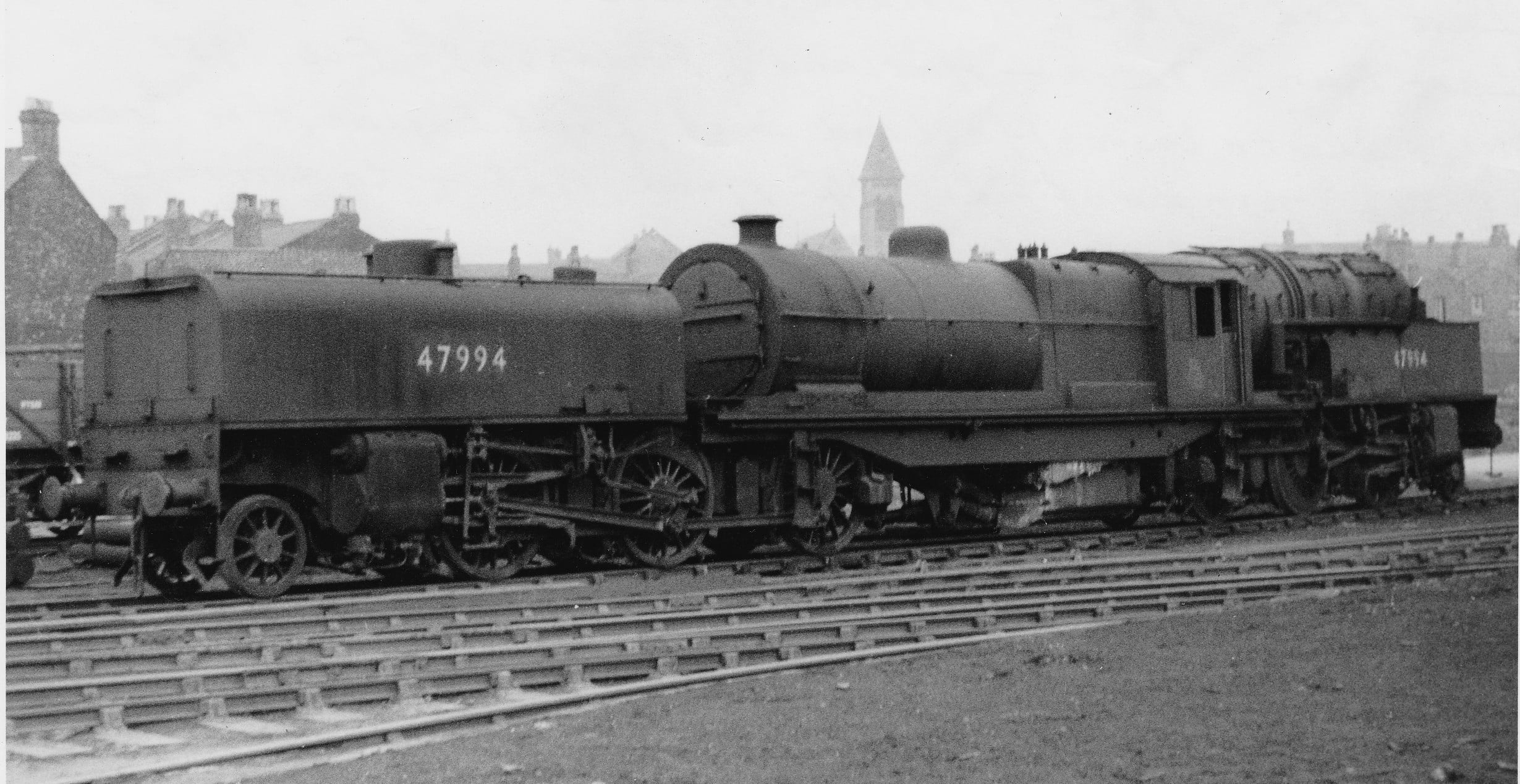
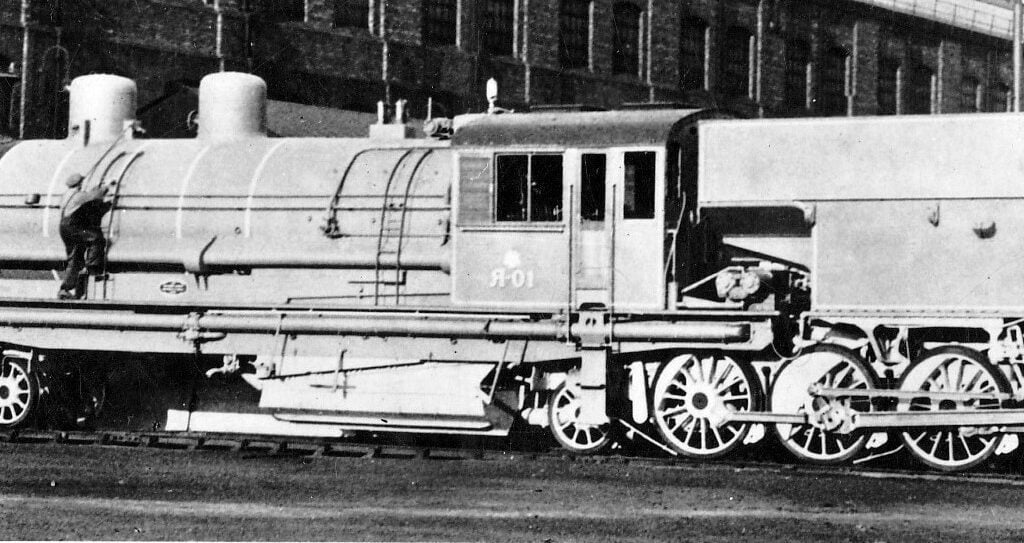
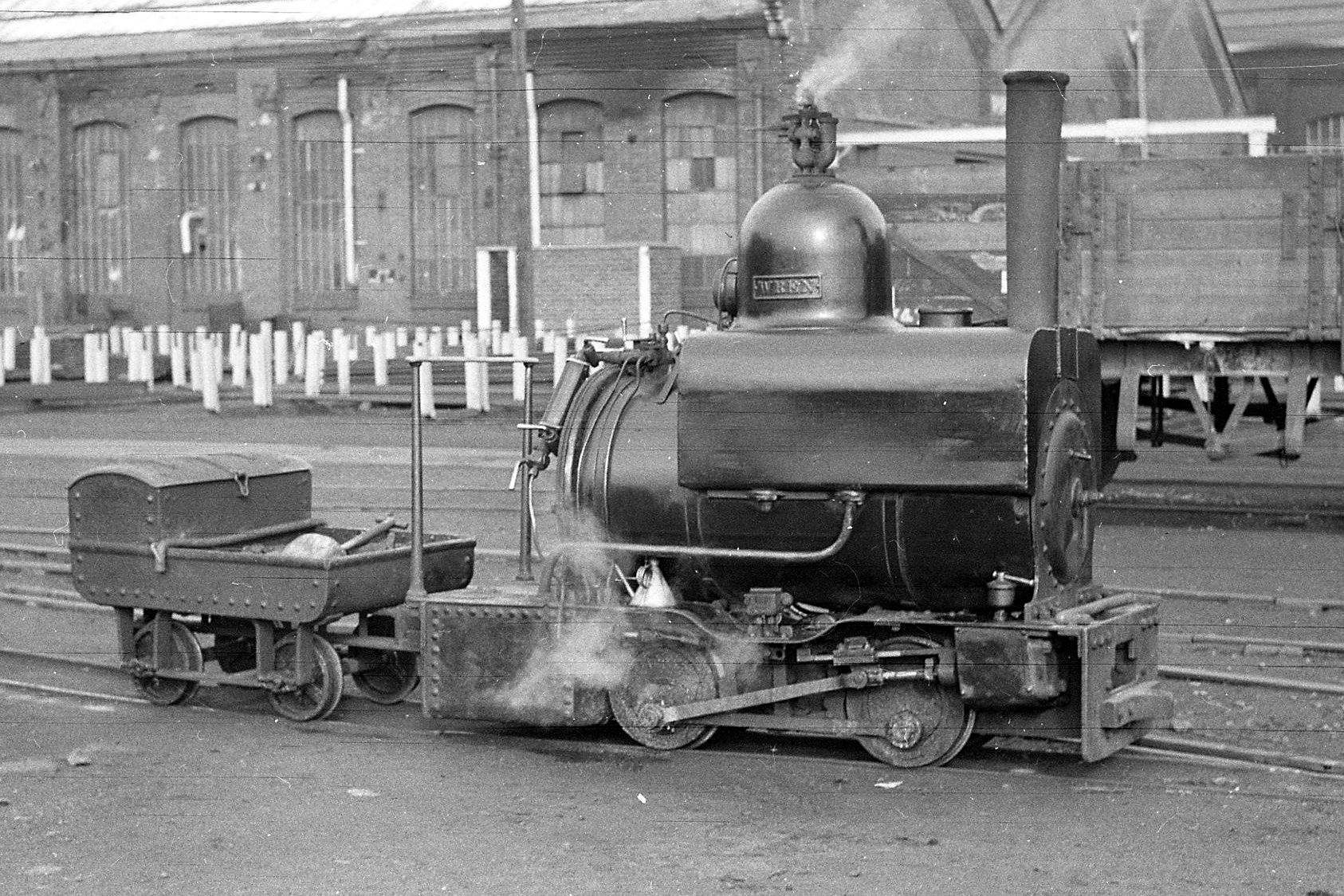
The Little ‘n’ Large of BR steam comprised the diminutive Wren that earned its keep working on the narrow gauge tramway at Horwich Locomotive Works, and a massive 2-8-0+0-8-2 Beyer Garratt, built to bank trains up the Worsborough incline.
18-inches Apart.
So, let us start with Wren.
During the late 1840’s the Lancashire & Yorkshire Railway opened its locomotive works at Miles Platting. However, the site limited in space with little or no room for expansion. Things came to a head at a directors meeting on 21 March 1884. The company’s consulting engineer, John Ramsbottom (a former Chief Mechanical Engineer of the LNWR), laid it on the line that Miles Platting was no longer fit for purpose and an alternative must be sought.
Also at the meeting was the company’s estates manager Elias Dorning who mentioned that a 650-acre site at the village of Horwich near Bolton was due to be auctioned at the Mitre Hotel, Manchester, in just six days’ time.
Dorning, Ramsbottom, and L&Y Chief Locomotive Superintendent William Barton Wright headed for Horwich to assess suitability. Dorning was instructed by the company’s directors to attend the auction but set a limit of £65000.
Dorning secured what the L&Y required for £36000 (about £3.76 million in 2025).
Construction began during January 1885 and just six months later the foundations of the Erecting Shop had been laid.
The works officially opened for business on 15 November 1886, though initially for locomotive repairs only. In February 1889, Horwich turned out its first new locomotive.
An integral part of Horwich was its 18-inch (460 mm) gauge tramway. Horwich was not the first to make use of an internal narrow gauge tramway. Ramsbottom had been the driving force in persuading the London & North Western Railway to install an 18-inch system at Crewe Locomotive Works.
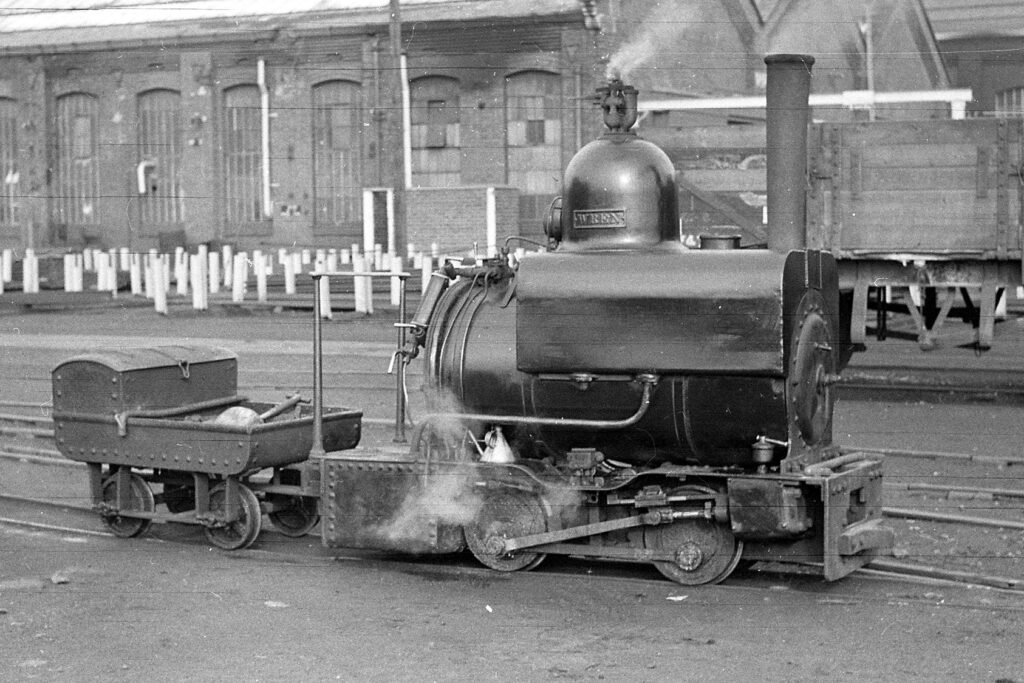
Closer to Horwich, Ramsbottom and Barton Wright would have seen locomotive manufacturers Beyer Peacock & Co, Gorton, moving stuff around their works by means of an 18-inch gauge railway.
The motive power at Beyer Peacock was an 0-4-0 well-tank named Dot and a saddle tank version of Dot was adopted for use at Horwich. Beyer Peacock supplied Horwich with two saddle tanks in 1887 at a cost of £268 each. Each loco weighed 3tons 11.5cwt and had a tractive effort of 1410 Ib. They were each fitted with a tiny four-wheel tender.
As Horwich expanded so the tramway expanded with it. Eventually approximately 7.5 miles (12.1 km) of 18-inch gauge track were laid enabling materials to be moved efficiently around a works covering 350 acres. As a result, more locos were required so that by 1901 the fleet reached its maximum strength of eight engines. Of these, three had been supplied by Beyer Peacock, and five built in-house at Horwich.
Over the years more efficient means of moving materials became available, and the tramway declined. On the formation of British Railways only Wren survived. One of the original pair supplied by Beyer Peacock in 1887, Wren was taken out of service in 1961, her duties finally taken over by ZM32 a 20hp Rushton four-wheel diesel-mechanical shunter supplied to Horwich in 1957. Wren was officially withdrawn in 1963 and preserved.
The Beast of Worsborough.
In 1880 the Worsborough branch of the Great Central Railway was opened for traffic. It was strictly freight only (mainly coal trains) and had been built to alleviate congestion through Barnsley. The line bypassed the town, connecting with the existing Barnsley – Penistone route at West Silkstone Junction just outside Penistone.
Avoiding Barnsley came at a price and that price was the Worsborough bank (or incline), 7 miles (11km) long embracing a notorious 3-mile (4.8km) section with a gradient of 1 in 40. Worse still was that the 1 in 40 featured Silkstone No.1 and Silkstone No.2 tunnels, veritable Hell holes for footplate crews.
To get a heavy coal train up the 1 in 40, usually two bank engines would be attached the rear of the train at the bottom of the incline at Wentworth Junction and assist as far as Dunford Bridge, 5 miles (8km) west of Penistone on the line to Manchester London Road.
By the 1920s, the incline was truly notorious as colliery subsidence was affecting the gradient profile. The result was sections more severe than 1 in 40 and heavy trains slowing to walking pace. As with the Woodhead tunnel, a driver and fireman often resorted either in lying down on the footplate or wrapping a wet handkerchief over their mouths to breath.
During 1924, the LNER Chief Mechanical Engineer, Nigel Gresley, produced a radical plan. A Beyer Garratt articulated locomotive would be powerful enough to assist as far as West Silkstone Junction, thereby requiring just a single bank engine to continue pushing to Dunford Bridge.
Gresley designed what would be the most powerful steam locomotive to run in the UK.
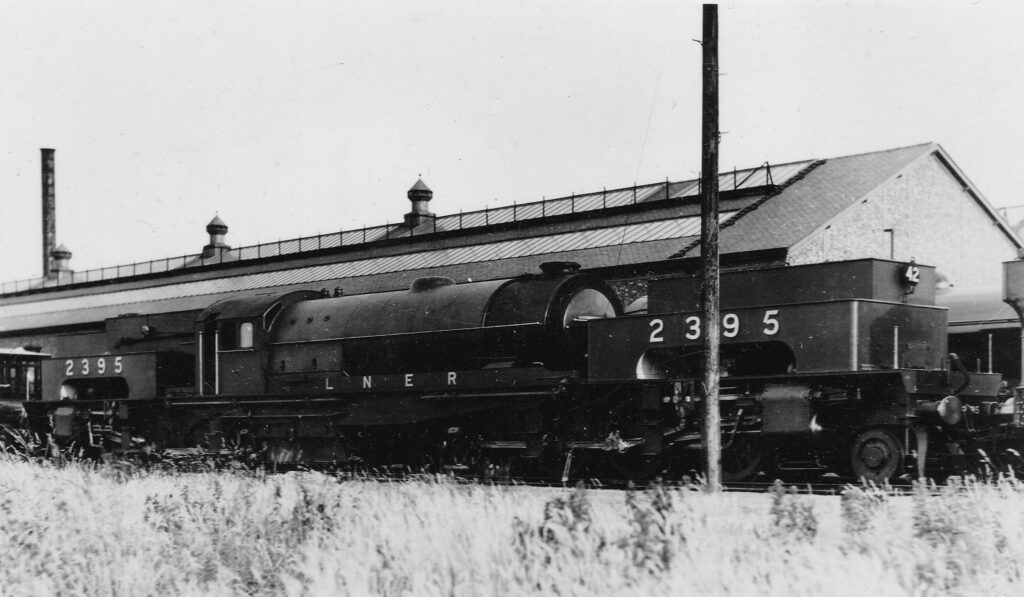
The order was placed with Beyer Peacock on 8 April 1924 for a 2-8-0+0-8-2 weighing 178t 1cwt (180907.2 kg) in working order. Its length over buffers was 87ft 3in (26.59m), water capacity 5000 gallons (22730.45 litres), coal 7tons (6350.2 kg). Originally Beyer Peacock had supplied a quote of £25000 for two locos though only one was ordered at a cost of £14895 (about £784,540 in 2025).
Construction did not commence until 1925 and then it became a rush job as the LNER wanted to steal the limelight at the Stockton & Darlington Railway Centenary Celebrations locomotive parade.
It took Beyer Peacock just three weeks from the frames being cut for LNER No.2395 to be steamed at Gorton for the first time. The LNER designated the beast class U1.
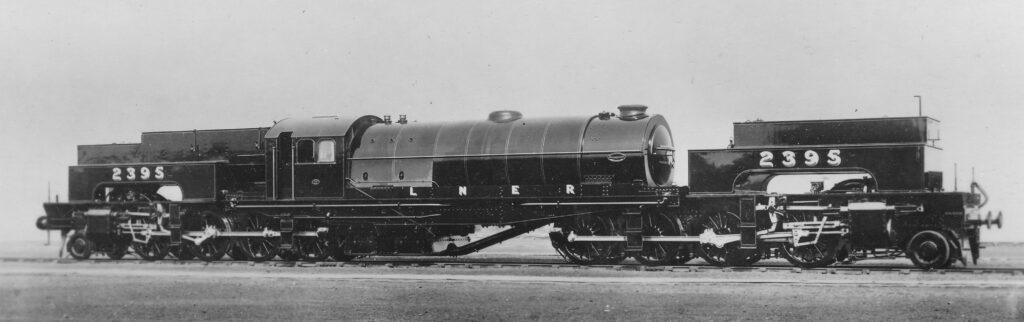
At Wentworth Junction at the bottom of the 1 in 40 incline, a coal train would arrive with a bank engine already attached (usually a class O4 2-8-0). 2395 would then attach to the banking O4 for the final push and detach at West Silkstone Junction. On average 2395 made 18 return trips a day.
The two Silkstone tunnels were truly awful for footplate crews. On any train 2395 was the last of three locos to enter the tunnels thereby suffering the accumulated effects of the other two engines. Gresley did include a gas mask-style air supply for the driver and fireman. However, the air was drawn via an air line at rail level rather than adopting independent air supply such as that afforded by a WWI gas mask. Inevitably crews kicked up over sharing Gresley’s masks on the grounds of hygiene, many resorting to the tried and tested method of a wet handkerchief over the mouth and nose.
The rush to complete 2395 might well have contributed to design flaws. The soft water in the area resulted in the boiler having to be retubed within eighteen months of 2395 entering service. Inspections in 1927 and 1928 revealed damage to the firebox which had to be replaced in 1930.
Before the outbreak of the second world war the LNER had planned the electrify the former Great Central lines from Manchester London Road to Sheffield Victoria and Penistone to Wath. Of course, the war put a stop to it, and it was not until the early 1950’s that BR was in the position to resume the project.
With impending electrification the Garratt, by now renumbered 69999 by BR was despatched for trials on the Lickey incline at Bromsgrove. However, footplate crews reported problems with visibility, after all 69999 was designed to push coal wagons and not passenger coaches. The problem was worse after dark and during November 1950 the Garratt returned to its home at Mexborough motive power depot where it was placed in store.
By February 1951, 69999 was back on its home turf banking the Worsborough incline though on 6 August 1952 she was sent to Gorton Locomotive Works for modifications in lieu of another attempt to make her suitable for working the Lickey.
69999’s stay at Gorton lasted for 394 days during which time she was equipped with improved electric head and taillights as well as being converted to oil burning. This included replacing the coal bunker with a 5000gallon (22730.45 litres) fuel tank.
The Garratt was reallocated to Bromsgrove MPD (21C) on 3 July 1955 in time for the heavy summer traffic. Indeed, a passenger on a train going up the Lickey might well have had his or her train banked by 69999. However, it appears 69999 was in store at the Lickey incline loco shed at Bromsgrove, when she was reallocated to Burton-upon-Trent MPD (17B) on 13 September.
Her stay in the brewery capital was brief as on 3 October she was reallocated to Gorton MPD (39A). On 23 December, after 30 years, six months and two days in service, 69999 was officially withdrawn and quickly despatched to Doncaster Works where she was broken up a few months later.
In the end Little had put in 44 years more service than Large.

Clive is our Transport and Railway writer, with years of experience he is a fount of knowledge on all things transport nostalgia.