
When British Railways was formed it inherited around 20,000 steam locomotives of all shapes and sizes. The oldest, and perhaps one of the more unusual of them was the one pictured here. This is LMS 7217 (later LMS 27217) a 0-4-2 saddle tank crane engine which survived to become British Railways 58865.
Ordered by the North & South Western Junction Railway from Sharp Brothers, Atlas Works, Great Bridgewater Street, Manchester, the loco (built as a 0-4-0 saddle tank) was delivered during 1858.
Located in West London, the N & SWJR was a short line linking the London & North Western at Willesden with the London & South Western at Brentford. The engine was, however, built to haul passenger trains on the N & SWJR branch line to Hammersmith.
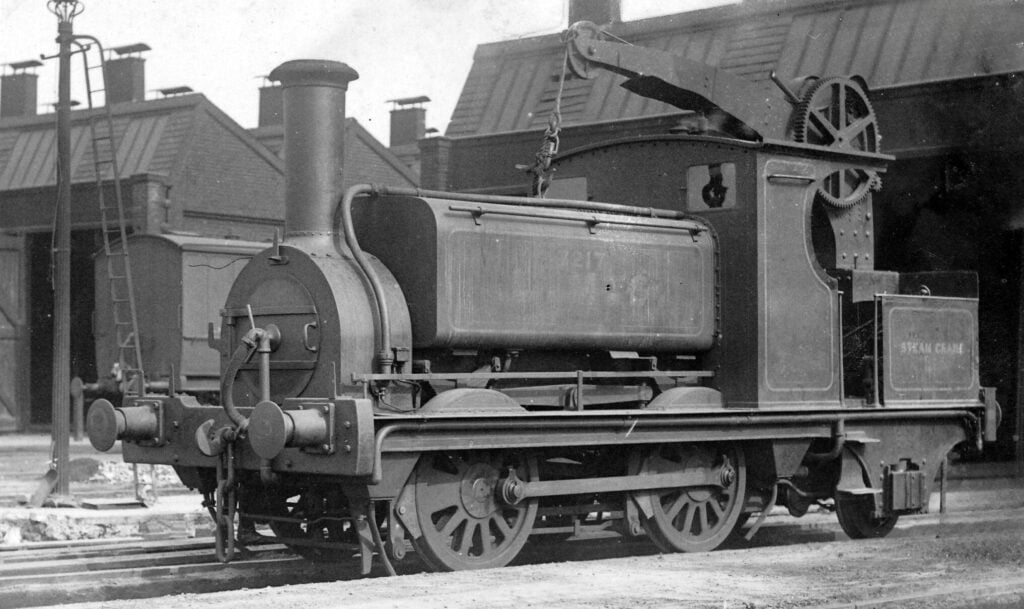
The N & SWJR was soon taken over by the North London Railway (where it carried the number 37) and some years later the NLR chief mechanical engineer, J C Park, had number 37 rebuilt as a 0-4-2 saddle tank crane engine at Bow Locomotive Works.
The additional pair of wheels supported the weight of the crane. Though the crane could be rotated, the jib was in a fixed position in order to ensure stability.
Crane engines could not only lift and move stuff around, but they could also carry out normal shunting duties. They tended to be employed around railway workshops. They were also used in industry.
On 1 February 1909, the NLR was effectively absorbed into the London & North Western Railway (LNWR) and on 1 January 1923, the LNWR was merged into the London Midland & Scottish Railway (LMS).
In early February 1951, British Railways officially withdrew 58865 from service and by the end of the month it had been moved to Derby Locomotive Works. A couple of months later it was still in the
Works yard though it had been covered with a tarpaulin. Any consideration of preserving the engine was given the thumbs down and it was cut up during October 1952.

Clive is our Transport and Railway writer, with years of experience he is a fount of knowledge on all things transport nostalgia.