
During 1957, cinema goers in the UK were in for a treat with The One That Got Away, starring Hardy Kruger as Luftwaffe pilot Oberleutnant Baron Franz von Werra. Produced by Earl St John and Julian Wintle, and directed by Roy Ward Baker, the film, based on a true story, followed the exploits of von Werra after he was shot down and taken prisoner during the Battle of Britain. Eventually he escaped from captivity and made it back to Germany. He was the only member of the German armed forces so to do.
Moving on. On Friday, 3 October 1941, a small group of newspaper photographers, journalists, and a film crew from Pathe News, were huddled together on the dockside at Barrow-in-Furness. As to why they had been summoned was still classified though some might well have had an inkling.
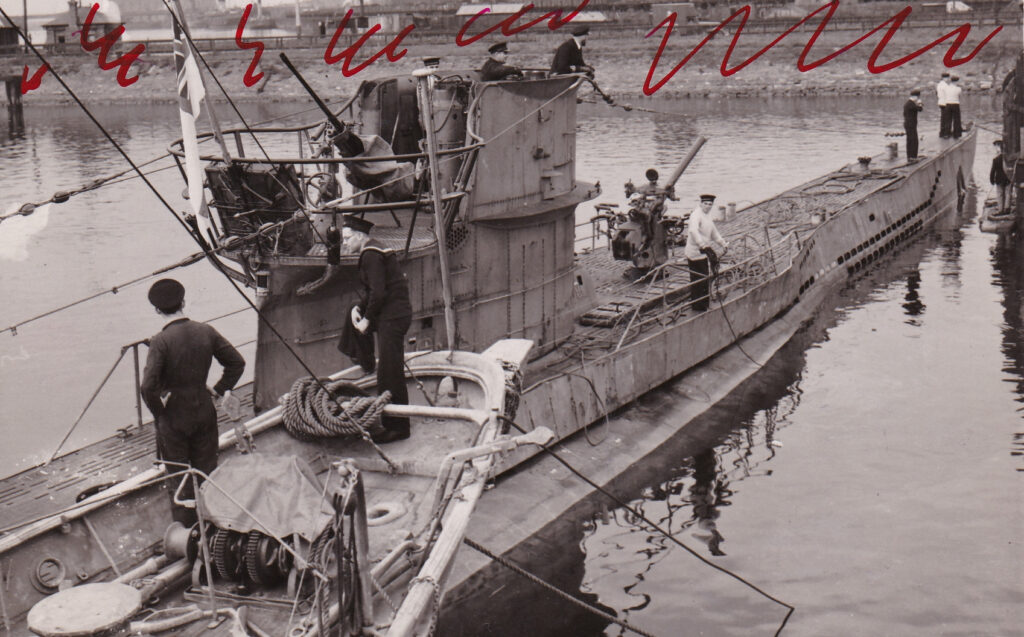
Any questions they had were answered when the Royal Navy hove into view with their first captured German U-boat of the war. Subsequently all photographs taken of the U-boat and the associated copy had to be submitted to the Press & Censorship Bureau for clearance.
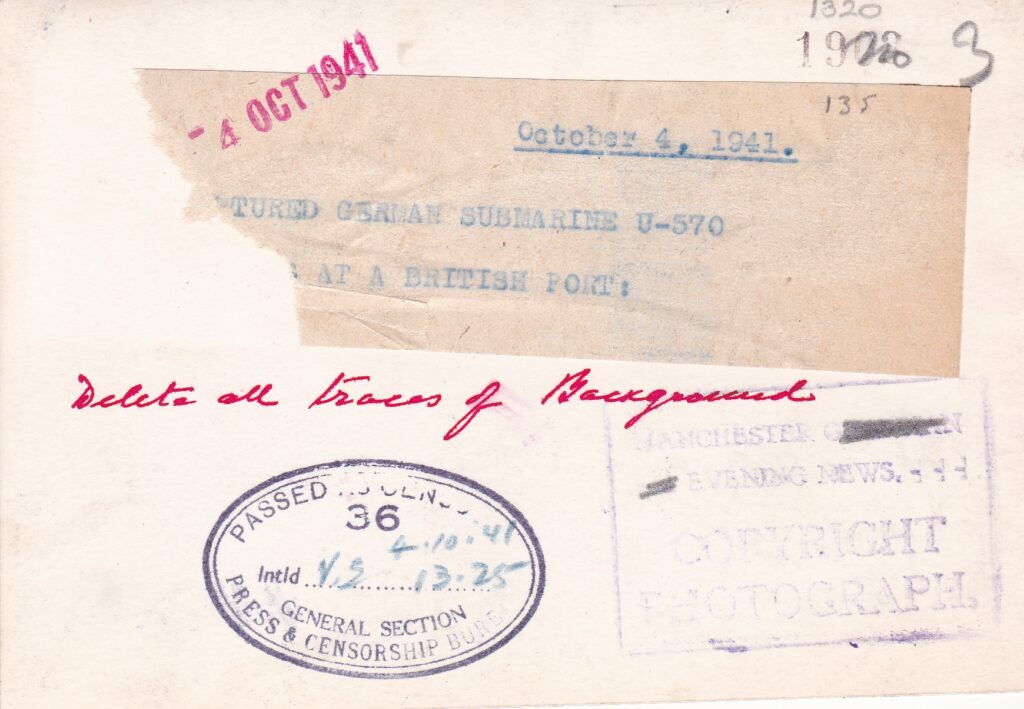
As the capture was considered a major coup, the government was keen to publicise the boat’s arrival in the UK. The Bureau pulled out the stops, returning images and copy within hours. The images and copy were then made available to all British newspapers ‘as censored’ under the terms of the wartime press rota agreement.
The only condition the Press & Censorship Bureau insisted upon for the Manchester Evening News image reproduced for this article was that any landmark that might reveal the location of the U-boat be removed prior to publication. Similarly, Pathe News had to carefully frame their newsreel so as not to give away the location.
U570
U570 was a Type VIIC ocean-going U-boat launched on 21 March 1941 at the Blohm & Voss shipyard, Hamburg, and commissioned into 3 U-Flotille on 15 May. The Type VIIC displaced 769 tons surfaced and 871 tons submerged. Equipped with five 21-inch (53.3 cm) torpedo tubes (four forward, one astern), an 8.8 cm deck gun and a light AA gun, U570 had a range of 8500 nautical miles (9800 miles) and was capable of diving to a depth of 750 ft (230 m). Crush depth, whereby the hull would implode was calculated at between 820 and 960 ft (250 and 295 m). On the surface, her powerful diesel engines could give her a top speed of 17.7 knots (20.4 mph, 32.8 km/h), faster than some Royal Navy escort vessels. Submerged, her batteries could produce a top speed of 7.6 knots (8.7 mph, 14.1 km/h), though maintaining it for extended periods would quickly drain battery power and force her to surface to recharge them. The typical crew of a Type VIIC was 4 officers, 3 chief petty officers, 11 petty officers, and 25 ratings. A total of 43.
Much of what follows is an amalgamation of information published in Admiralty Naval Intelligence Division files C.B.4051 (31) dating from October 1941, and C.B. 4318 R released during January 1943. C.B. 4051 (31) was compiled following the interrogation of the crew of U570, whilst C.B.4318 R concentrates on the operational capabilities of the Type VIIC. It does, however, include further information regarding the U-boat’s capture as well as damage it sustained. At the time, both files were subject to restricted access. Anyone reading C.B 4051 (31) was warned that as it was derived from statements made by prisoners of war, and those statements that could not be verified from other sources ought not to be taken as fact.
Two days after commissioning, U570 sailed to Kiel to begin acceptance trials. Though skippered by Kapitanleutnant zur See Hans-Joachim Rahmlow, the boat was under the full command of officers of the U-boat Acceptance Commission.
Following her trials, U570 departed the naval base at Horten in Oslofjord, Norway, on either 20th or 21st July for Trondheim, though still under the command of Acceptance Commission officers. The voyage was made on the surface though somewhere between Bergen and Alesund a surprise attack by a British aircraft on a nearby Norwegian ship (approximately 6-7 miles off), resulted in U570 crash diving. In doing so she hit the bottom damaging the bow, a hydrophone, the cap of No.3 torpedo tube, and wrecking the A.E.G. detector. The boat remained submerged for 30-40 minutes before surfacing.
U570 arrived at Lo Fjord naval base thirteen miles north of Trondheim, on 25 July. As it was necessary to undertake a thorough investigation of the damage to her bow, the decision was taken to move the boat to Trondheim. Unfortunately, U-boat facilities there were still under development and the only dock capable of taking U570 was already occupied. Eventually repairs were carried out. However, due to the rapid expansion of the U-boat Arm, there was a shortage of skilled technicians and maintenance engineers at Trondheim, which resulted in her A.E.G. detector remaining out of action.
The A.E.G. detector (S-Gear) was a retractable short-range supersonic echo-ranging device primarily for detecting mines. It had a maximum range of 500 metres and was deadly accurate at 300 metres. The British were aware of the device’s existence and that it was just emerging from its experimental stage. At the time the British believed U570 was the first boat fitted with it for operational use.
Further trials followed with officers of the Acceptance Commission still in command, and it was mid-August before Rahmlow was finally got his hands on the boat.
War Patrol
U570 departed on her first war patrol from the naval base in Lo Fjord, Norway, at 0800 hrs on 24 August. She was accompanied to sea by U568 and an armed trawler.
Though a career officer, Rahmlow had only recently transferred to the U-boat Arm. His only previous experience as a U-boat commander had been of the small Type IIC boat U58 during a training exercise in the Baltic. As for his crew only Ingenirur-Unterleutnant (Engineer Officer) Erich Menzel, Obersteuermann (Chief Quartermaster) Otto Grotum, one or two petty officers and one rating had any previous experience of a U-boat war patrol. Despite this crew morale was high, many believing the war would be over by the summer of 1942 and Germany would be victorious.
Initially Rahmlow’s orders were to proceed to a patrol area to the south of Iceland, via north of the Shetlands, and north of the Faroe Islands. It was to be a four-week cruise during which U570 was to seek out and destroy enemy shipping. The U-boat was then to proceed to La Pallice, France.
According to C.B.4051 (31), the voyage was made mostly on the surface though it was not without incident. For some inexplicable reason, the valves on one of the U570’s two diesel engines were not securely seated resulting in its cooling system malfunctioning and the engine overheating. Until Ingenirur-Unterleutnant Menzel and his men could fix the problem, the boat proceeded on one engine. No sooner had the engine been fixed than the injector pumps began playing up. Additionally, one of the torpedo tube doors and one of the diesel exhaust pipes were both leaking water into the boat.
U570 had been in her assigned patrol area for only a few hours when German Naval Intelligence (B-Dienst) advised that a large east-bound convoy (HX 145) was approaching. U570 was ordered to join the attack. The convoy comprising 85 merchant ships and 22 escorts, had departed Halifax, Nova Scotia on the 16th and was due to reach Liverpool on or about the 31st.
On leaving his operational area Rahmlow was advised that 10-12 other U-boats were attempting to intercept the convoy. However, it was not long before Rahmlow’s attack order was rescinded, and he turned on a more northerly course. In C.B.4051 (31), some of the crew believed it was due to a signal being received that the convoy had altered course. Rahmlow estimated he would intercept HX 145 at some time on the 28th.
Dawn on the 27th found the U-boat on the surface attempting to make headway in heavy seas. At about 0830 hrs and with many of his inexperienced crew incapacitated by sea sickness, Rahmlow dived the boat to 30 metres in the hope that calmer waters would ease the problem. C.B.4045 (31) makes no mention of this being a crash dive due to an attack by a Coastal Command 269 Squadron Lockheed Hudson piloted by a Sergeant Mitchell. The depth charges carried on Mitchell’s aircraft failed to release.
At around 1050 hrs at Rahmlow surfaced the boat at approximately 62.15N, 18.35W, without first going to periscope depth and taking an observation for hostile aircraft. However, such an observation might not have been possible due to the heavy sea conditions. As it was, U570 surfaced directly under the flight path of a Coastal Command Lockheed Hudson bomber from 269 Squadron. Though Rahmlow immediately ordered crash dive, the crew of the Hudson wasted no time in dumping a pattern of four 250-pound depth charges. The nearest detonated less than ten metres from the U-boat.
On board U570 chaos reigned as the glass fronts to gauges and dials shattered. All electrical power failed, and a gas formed which was thought by her crew to be chlorine gas. An ingress of water appears to have convinced Rahmlow his boat was done for and ordered the blowing of the ballast tanks. As the boat began to rise, he ordered the crew to don lifejackets and to mount the conning tower once the boat had surfaced.
Surrender
As Acting Squadron Leader James Thompson turned his Hudson for a second pass, he observed 10-12 members of U570’s crew on deck. Thinking they were attempting to man the guns; Thompson ordered his air gunners to open fire. However, due to the heavy sea there was no chance the U-boat could return fire. Shortly afterwards, Thompson and his navigator Flight Officer John Coleman spotted a white flag (a bed sheet) being waived from U570’s conning tower. The Hudson, unable to take the surrender immediately radioed for help.
Thompson continued to circle until 1345 hrs when he was relieved by a Coastal Command Catalina flying boat from 209 Squadron.
At some point following the arrival of the Catalina, the crew of U570 threw confidential books and the cypher machine overboard. Other onboard equipment wrecked included the A.E.G. detector. U570 signalled German Naval Headquarters in plain language that it was unable to move. The signal was intercepted by the British and Admiral Percy Noble, Commander-in-Chief Western Approaches, wasted no time in ordering surface ships to the area.
The first warship arrived on the scene at 2250 hrs, guided to the U-boat’s position by flares dropped from the Catalina. It was the anti-submarine trawler HMS Northern Chief.
As the last thing the navy wanted was for Rahmlow to scuttle, Northern Chief signalled “If you make any attempt to scuttle, I will not save anyone and will fire on your raft and floats.”
It had the desired effect. U570 replied “I cannot scuttle or abandon; save us tomorrow please.”
U570 was ordered to display a small white light to ensure contact was maintained throughout the night. The Catalina was then able to return to base after spending thirteen hours circling the U-boat.
Reinforcements in the shape HM trawlers Kingstone Agate and Northern Prince arrived and at 0330 hrs they swept for mines: Northern Prince to the west of the U-boat, Kingston Agate to the east.
At around 0550 hrs, the destroyer HMS Burwell (ex USS Laub) and the anti-submarine whalers HMS Wastwater and HMS Windermere arrived.
The Canadian destroyer HMCS Niagara (ex USS Thatcher) arrived at 0802 hrs, followed three minutes later, a Northrop N-3PB single-engine floatplane bomber, which then proceeded to depth charge U570 and strafe Northern Chief. The trawler returned fire with its AA guns though ceased once the plane had been identified as belonging to 330 (Norwegian) Squadron. Burwell ordered to aircraft to break off.
Rahmlow signalled asking for the immediate evacuation of his crew. He claimed his boat was making water aft though he was not believed as the boat’s trim of being down slightly by the head hadn’t altered.
At 0835 hrs and not without considerable difficulty, a towline was successfully passed to the Burwell: Windermere assisting by lying to windward and pumping fuel oil onto the turbulent waters. Even though it was a destroyer, the Burwell lacked manoeuvrability. This was due to both of her screws turning in the same direction thereby making Burwell sluggish on the helm. At 0915 hrs the tow parted.
By now the upper casing of the U-boat was awash and three attempts by the Windermere to take up the tow failed.
At 1030 hrs the U-boat was settling by the head. Rahmlow signalled that he could not remain afloat for much longer. The response was that he should lighten ship, blow ballast, and pump out fuel oil. As the U-boat’s crew appeared to be ignoring the signal, Burford fired its starboard .50 calibre machinegun over the coning tower but due to the heavy sea the gunner’s aim was spoilt and five of Rahmlow’s crew were wounded. A white flag was raised for a second time, and the U-boat began blowing out water and oil. For the first time U570 appeared to have surface trim.
At 1035 hrs Kingston Agate reported that she was fitted for towing. The trawler closed the wallowing submarine and shot a line. Once secured, Lieutenant H B Campbell and a small boarding party attempted the hazardous task of hauling themselves and the towrope across by means of a Carley life raft. Sea conditions were such that it was 1350 hrs before the men managed to board. Even then they had to crawl along the submarine casing dragging the towrope with them. Eventually they secured it to the U-boat’s stern.
With tow and lifelines attached the slow process of transferring the wounded and the officers to Kingston Agate began. In the meantime, at 1402 hrs, the boarding party reported that all confidential books and instruments had been destroyed, though a few documents recording signals written in plain language and their corresponding encryptions remained intact. Another important find was a copy of a U-boat commander’s handbook revealing fascinating information on Kreigsmarine abbreviations used in signals traffic. Lieutenant Campbell also reported that there was a build-up of chlorine gas. Prisoners later stated that the chlorine had been aggravated by the second (Norwegian) bombing.
Niagara then came alongside the U-boat and took off the remainder of the crew.
Kingston Agate took up the tow, slow, dangerous work in calm weather let alone heavy seas. It was only a matter of time before the tow parted and when it did at 1930 hrs, Kingston Agate was ordered to make for Iceland at best speed.
At 2057 hrs Northern Chief took over, Coastal Command providing round-the-clock air cover. The plan was to beach the submarine bow on to the shore at Thoralkshafn. However, on the 29th she grounded herself broadside on listing heavily to starboard (towards the beach).
Under the command of Lieutenant George Calvin, a group of technicians carried out an initial assessment. According to C.B.4318 R, the interior was chaotic. Leaks of oil and water had mixed with provisions including flour, dried peas, beans, soft fruit, the remains of scores of loaves of black bread as well as clothes and bedding to form a morass that in places was knee deep. Adding a little spice to the mix were the contents of several bucket loads of excrement. This was due to the practice of using the crew’s toilet as an additional food locker.
The same file listed the damage caused by depth charges. It included a 3-inch split in the pressure hull on the port side, and 90 per cent of the battery containers cracked. The bulkhead between both battery tanks and the internal oil fuel tanks was slightly buckled. One of the two pairs of 500-amp fuse holders was broken, and this had resulted in the loss of all lighting and power to the auxiliaries. Battery supply switches to the main motor switchboards had jumped off but were not damaged. He also reported that gauge glasses, lights, porcelain fuses and a few minor bracket welds were broke.
In C.B.4051 (31) Calvin reported that though the forward main ballast tank was holed, the main motors, main engines, pumps, compressors, auxiliaries, and so on appeared to be undamaged and the main battery tanks (two) dry and sound. Despite the damage, Calvin’s assessment was that a well-trained/experienced crew ought to have had little difficulty improvising repairs and diving U570.
Between 31 August and 0500 hrs 5 September, U570 was made seaworthy. The salvage tug Salvonia was then tasked with hauling the U-boat off the gently shelving sandy beach. At 1300 hrs the tow to Hvalfjord commenced and by 0900 hrs the following morning U570 was alongside the depot ship HMS Hecla.
On 25 September, U570 was declared ready for sea under her own power, though she remained unable to dive due to damage done to her fore planes when she ran aground. After trials she sailed on the 29th under the command of Lieutenant Calvin for Barrow in Furness where thorough repairs would be undertaken. The passage was made on the surface, U570 being escorted by the destroyer HMS Saladin and the Kingston Agate.
U570’s arrival at Barrow on 3 October was early enough for evening edition newspapers to carry a paragraph that a captured U-boat had docked in a British port.
On 5 October U570 was commissioned into the Royal Navy as HMS Graph.
Council of Honour
The story does not end there. By the time the U-boat’s officers, Oberleutnant zur See Bernhard Berndt, Leutnant zur See Walter Christiansen, and Ingenirur-Unterleutnant Erich Menzel arrived at Grizedale Hall POW camp (the same camp where Franz von Werra was first held), news of their surrender had preceded them. Indeed, the award of DFC’s to Acting Squadron Leader James Thompson and his navigator Flying Officer John Oswald Coleman for their action in bringing about the surrender of a U-boat had been widely circulated in the press since mid-September. The press also reported that the U-boat’s naval ensign had been presented to 269 Squadron.
The officers were brought before a Council of Honour headed by none other than U-boat ace Otto Kretschmer. They were charged with cowardice. Christiansen and Menzel were cleared but First Watch Officer, Berndt, was found guilty and told he would face a court martial when the Reich was victorious following the surrender of the British.
According to C.B. 4051 (31), Berndt enlisted in the Kriegsmarine in 1935. Only recently had he transferred to the U-boat Arm after serving on destroyers. He was said to be an ‘uninteresting, arrogant young man and professed some contempt for the “Slackness and credulity” of the British. According to the ratings of U570 Berndt was a difficult and nagging superior, but neither efficient or knowledgeable.’
The Council of Honour offered Berndt an opportunity to redeem himself. The Germans had found out that U570 was undergoing a refit at Barrow-in-Furness. All Berndt had to do was make his way there (just 22 miles/35km away) and destroy it.
Accounts vary as to what happened next. One is that he was helped to escape during the night of Saturday18 and Sunday19 October, having first been supplied with civilian clothes and the identity papers of a Dutch seafarer. His cover story was that he was making his way to Barrow to find a ship.
Berndt’s freedom did not last long. Within hours he was discovered asleep under a tarpaulin in a sheep shelter by a Home Guard patrol. Berndt did not resist arrest and at first, he walked quietly under escort. Though he convinced the patrol with his cover story, they decided that just to be on the safe side they would take him to nearby Grizedale Hall.
For some reason, perhaps it was the thought of having to face Kreschmer and explain why he’d been picked up so soon, Berndt made a run for it. He ignored several calls to stop and was shot in the back. He died before medical aid could reach him.
Berndt’s escape was reported in the press on Tuesday 21st. In some, such as the Lincolnshire Echo, Gloucester Citizen, and Dundee Evening Telegraph, he is anonymous and described as a German Air Force officer. In others including the Manchester Evening News, Birmingham Daily Post, and Hull Daily Mail, and he is named and described as the commander of the U-boat recently captured by a Hudson Coastal Command aircraft. Some papers also reported the decision of the coroner not to hold an inquest.
Aftermath
Ironically, only a few days after reporting Berndt’s death, British newspapers were reporting that The One That Got Away, Baron Franz von Werra, had been shot down on 25 October. Berlin floated the story that he had again been captured by the British. In fact, his Bf109 fighter had suffered engine failure and crashed into the sea north of Vissengen in the Netherlands. His body was never found.
When Rahmlow arrived at Grizedale Hall, he too was told he would face a Council of Honour, though some sources claim he had already been tried in absentia and found guilty of cowardice. Whatever the reason, he was quickly moved to a camp for Luftwaffe officers near Carlisle.
It was not until November 1944, that the Admiralty confirmed U570’s commissioning into the Royal Navy though they did so without revealing it had been named HMS Graph. The appropriate paragraph in the Belfast News Telegraph (20 November), also claimed it had recently destroyed an enemy U-boat.
What makes the announcement interesting is that by then HMS Graph had been lying wrecked on the west coast of Islay for eight months. Having been decommissioned on 21 June 1943, HMS Graph had run aground on 20 March 1944 on its way to the breaker’s yard.
Anyone interested in reading the C.B.4051 (31) and C.B.4318 R can find them on the U-boat Archive.

Clive is our Transport and Railway writer, with years of experience he is a fount of knowledge on all things transport nostalgia.