Passenger trains were rare on the Waterside branch line at Hadfield. In fact, there appear only to have been a handful during the line’s 85-year history. In late 1904 as part of a drive to improve the town’s railway services, Glossop Council approached the Great Central Railway (GCR) about operating passenger trains over the branch. It was declined, though Sam Fay, chairman of the GCR, took time to reply to the council with the offer of making Dinting a request stop for some existing services.
Though the line was only a couple of miles long, its construction involved some serious civil engineering including diverting the course of the River Etherow.
The branch left the main line at Dinting Goods Station, Gamesley, on the Manchester side of Dinting Viaduct. It then crossed Glossop Road by means of a level crossing and continued past Brookfield Mill. Further on, the line crossed Woolley Bridge Road also by means of a level crossing enabling it to serve the Mersey Mill belonging to Thomas Rhodes & Sons, cotton spinners and manufacturers, as well as the nearby Hollingworth Print Works. The line continued to the Waterside Mill and terminated at the Bridge Mill. Owned by the Sidebottom family since 1828, these two mills between them formed one of Europe’s biggest textile factories.
The branch was worked on the one engine in steam principle, meaning that once the train was on the branch, the crew could shunt wagons to their hearts content in the knowledge that no other train would turn up.
Around 75 per cent of the traffic was coal for the mills. Big mills could burn several tonnes a day powering their looms and other machinery. Bridge Mills alone had 4000 looms.
Opened on 10 October 1879, the line quickly attracted the attention of kids with too much time on their hands. The earliest reference appears in the Glossop-dale Chronicle & North Derbyshire Reporter for Saturday, 8 November 1879. Eleven years old George Price, son of Herbert Price, had been up before the Glossop Borough Police Court on the 3rd, charged with “unlawfully and maliciously” interfering with a set of points at Lower Barn.
George used the point lever to hold the points open whilst his accomplice placed a stone in such a position that the points could not close or adjust themselves. The court was informed that the next wagon coming along would have been upset (derailed).
However, the boys were observed in the act by PC Fish, and though they legged it, Glossop’s finest gave chase and caught them. The boys gave their names and addresses and were told they would be reported to the Manchester, Sheffield & Lincolnshire Railway.
The MS&LR brought a prosecution though Mr Harpur, their solicitor, said that because of George’s age the company wanted it to serve as an example to others. The chairman of the bench, Alderman Rowbottom (Mayor of Glossop), ordered George to be discharged on payment of costs though not before extracting a commitment from the boy’s father Herbert Price to take more care of his son.
Moving on to Monday 20 July 1914, and no fewer than sixteen boys from Hadfield were up before the magistrates at a Children’s Court. They were charged with trespass on the Waterside branch line of the Great Central Railway (GCR). The witness for the prosecution was Mr Cottrill, a railway detective, who stated that though considerable damage had been done, the GCR did not wish to press the cases severely and would settle for a nominal fine only. The GCR hoped the court appearance and attendant publicity would function as a warning to others.
The defendants were all bound over and ordered to pay the costs of the prosecution.
As the war to end all wars unfolded, trespassing on the Waterside branch became problematic as the line was pressed into service for the war effort. Part of the Waterside Mill was taken over to produce guncotton. Due to round-the-clock production the line received its own dedicated shunt engine.
After the war, the line reverted to normal service, though if it was anything like prewar, the love, hate, relationship with some of the locals was about to resume. Back in April 1908 Councillor Eastham demanded a letter be sent by the Town Clerk to the GCR drawing their “Attention to the nuisance caused by engine drivers continuously using their whistles at Lower Barn on the branch line from Dinting Goods Station to Waterside Mills”. Eastham claimed that the engines stopped at Mersey Mills, and as far as he understood, the engine drivers commenced to blow their whistles to waken the people at Dinting Goods Station. A comment greeted with much laughter from his fellow councillors.
To be fair to the GCR, their chairman Sam Fay replied within a couple of weeks. His letter was read to councillors. Sam had issued instructions that “drivers passing over the branch between Dinting and Lower Barn, and Waterside were not to use their whistles unless absolutely necessary to do so, and he trusted this would have the desired effect.”
During 1951, a reporter from the Glossop Chronicle was allowed to spend the day with the train crew, guard, and shunter as they worked the line. His account was published in the paper on 22 June 1951.
On 2 May 1959, the locals were surprised to see a tank engine slowly hauling three passenger coaches along the branch at little more than walking pace. It was a rail tour organised by the Rail Enthusiasts Club of Great Britain; a society known for touring some of the country’s more unusual lines. British Railway’s longest serving employee on the line was guard Jimmy Plant. Jimmy had forty years’ service on the Waterside, and he could not remember a similar event though older residents remembered that sometime in the distant past at least one special excursion train had taken mill workers on a day’s outing to Blackpool.
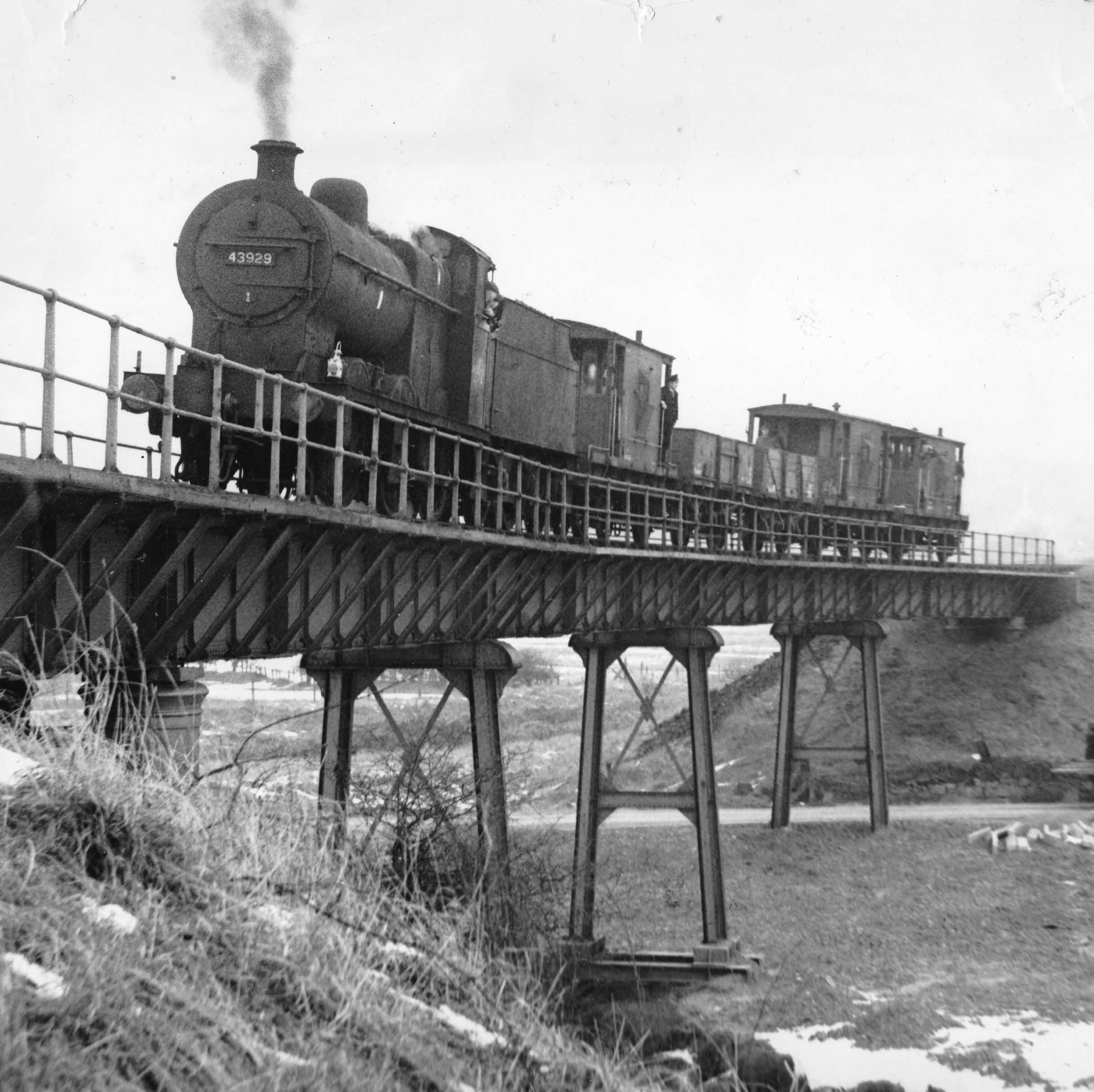
Our image shows Fowler 0-6-0 goods engine 43929 trundling across Brookfield Bridge (Melandra Viaduct) on 22 February 1964, with the very last train. Not only was it the last goods train, but it was also the last passenger train as it carried enthusiasts from the North West branch of the Locomotive Club of Great Britain.

Clive is our Transport and Railway writer, with years of experience he is a fount of knowledge on all things transport nostalgia.