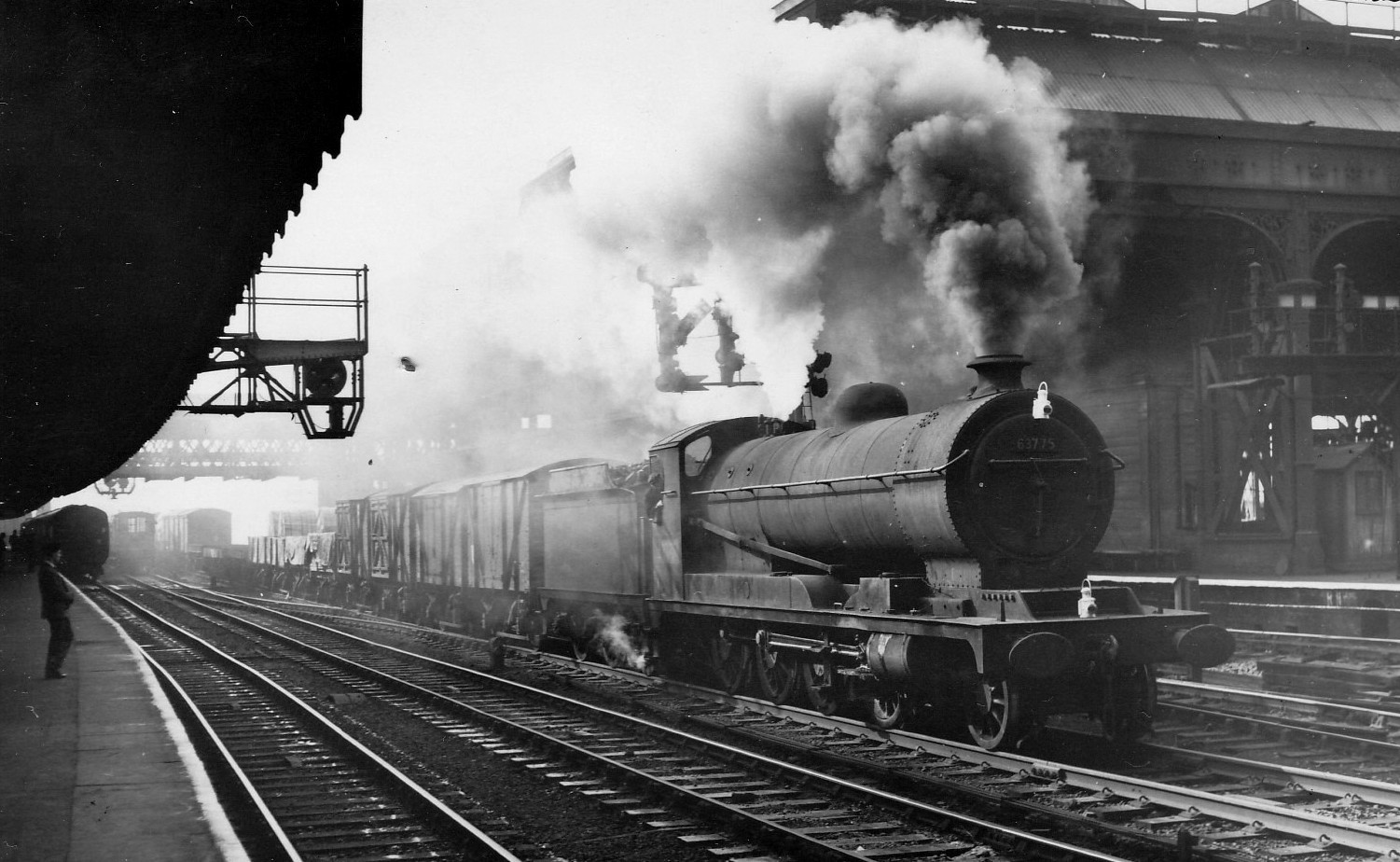
ROD 2-8-0 63775 is pictured here thundering through Manchester Victoria, her headlamps indicating she is hauling a through freight and not running under classes C, D, E, or F of the BR signalling regulations.
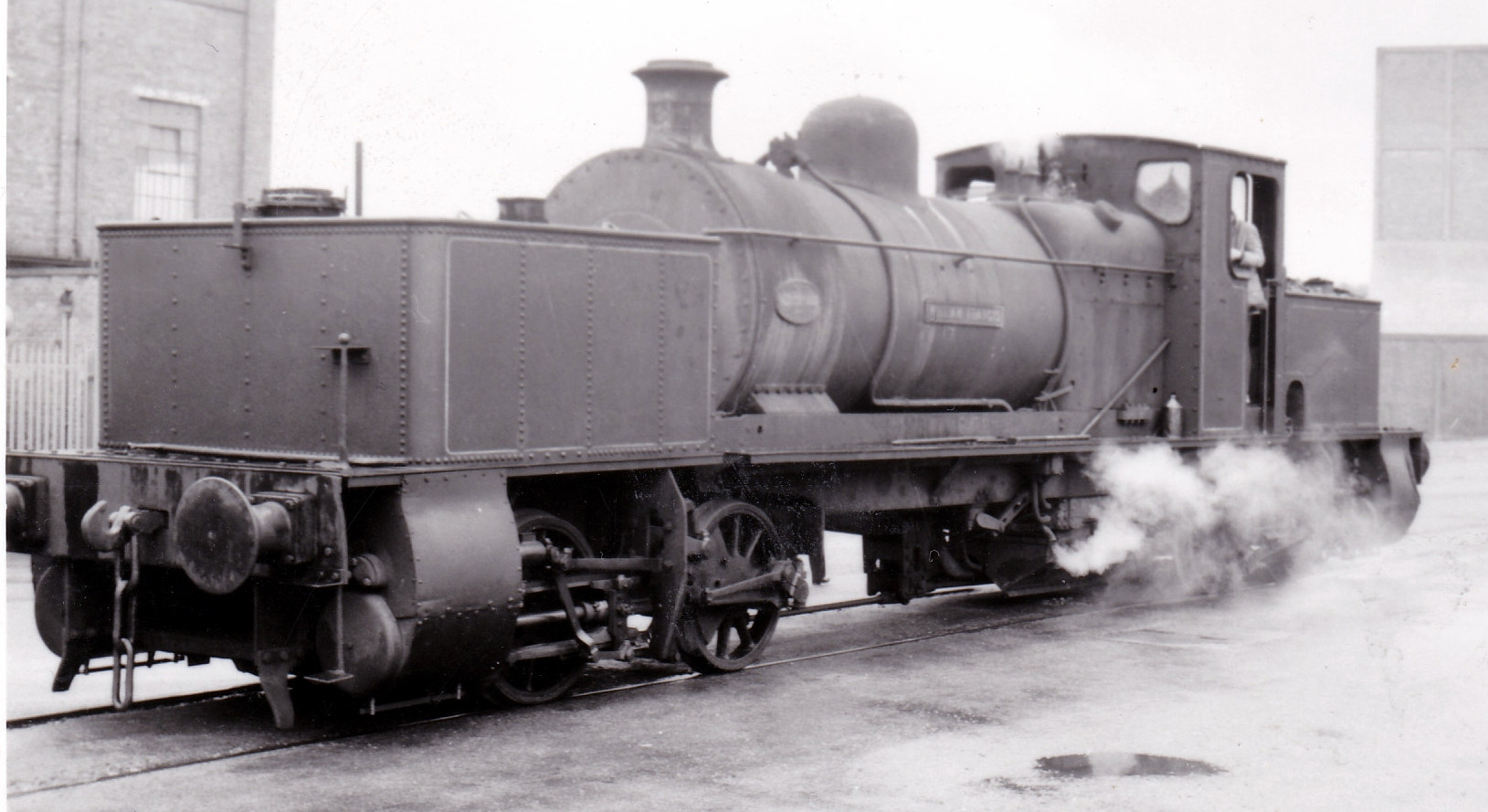
RODS was the name given by railway enthusiasts to the former LNER class O4 heavy freight 2-8-0 locomotives. What follows is a brief insight into the class and how they came about.
Our story begins as during the dying days of the Edwardian era.
In anticipation of the completion of Immingham Docks, the Great Central Railway’s (GCR) brilliant Chief Mechanical Engineer John George Robinson, has finalised his design for a freight locomotive capable of handling heavy coal trains from the Derbyshire and Yorkshire coal fields.
Designed by Sir John Wolfe Barry (who also designed Tower Bridge in London), the docks, covering 1230 acres, had been under construction since 1906; a joint venture between the Humberside Commercial Railway & Dock Co and the GCR.
Unlike Hull, Immingham was a tidal-free deep-water port enabling ships could come and go around the clock. Coal, grain, timber and produce were to be the most important commodities handled, and the GCR had already established a reputation in dock management with its successful handling of Grimsby.
The south quay would be the focus for handling coal traffic. Between them, the quay’s seven hydraulic coal hoists could handle 5000 tons per hour. One of the hoists was moveable, allowing it to be positioned to fill two holds at the same time. Each hoist was gravity fed from a siding holding 320 loaded wagons.
There were 170 miles of railway within the dock property. Sidings could accommodate 8000 loaded coal wagons, and the dock storage capacity for coal was estimated at 174,000 tons.
Robinson’s new design was designated class 8K by the GCR, though unbeknown back then it would prove to be one of most successful British steam locomotive designs of the pre-Grouping era. The 8K was a development of Robinson’s class Q4 0-8-0 freight locomotive design. However, the 8K was fitted with a larger boiler, piston valves, 21”x 26” cylinders, vacuum brakes, an 18-element superheater, and a two-wheel leading pony truck. The tender held 4000 gallons of water and was fitted with a scoop enabling it to refill from water troughs laid between the rails.
The first 8K (No.966) was built at Gorton Works, Manchester, during September 1911.
By the time Immingham Docks opened for business in May 1912, Gorton Works had completed 17 class K8 engines with three more (GCR Nos, 406, 407, and 408) due by the
end of the month and a further three (GCR Nos 346, 347 and 348) scheduled for completion in June.
Immingham was officially opened by King George V and Queen Mary on 22 July 1912. Their Majesties arrived by train from Grimsby then transferred to the paddle steamer Killingholme for a tour of the docks. All merchant ships present as well as three warships were dressed over all for the occasion. Killingholme had been transformed. She was shiny white and flew the Royal Standard.
After the tour their Majesties disembarked at No.1 Transit Shed which had been converted into a function pavilion for a convivial luncheon. However, the 1418 invited guests drank so much tea that a crisis on the boiling water front developed. Quick thinking by GCR chairman Sam Fay, resulted in a couple of dock shunt engines being positioned to maintain a ready supply.
At 3.30pm King George V declared Immingham officially open, borrowed a sword, ordered Sam Fay to kneel and knighted him there and then on the dockside.
At the outbreak of the Great War, the Ministry of Munitions requisitioned several hundred locomotives from Britain’s railway companies for use in France by the Railway Operating Department (ROD) of the Royal Engineers. However, it became apparent that needs would be best served if a standard design could be found.
With input from Sir Sam Fay the GCR’s class 8K was selected; the company already had over 100 of them in service, and they were proving to be reliable machines. The MOM specification differed from the GCR’s in that ROD engines would be equipped with a steam brake, and the tender would not be fitted with a water scoop.
Batch orders were placed with several commercial locomotive manufacturers the first being in February 1917. The last order for 188 locomotives was placed in September 1918. The North British Locomotive Co, Glasgow, supplied 369 locos; Robert Stepehenson 82; Kitson 32; Nasmyth Wilson 32, and the GCR Gorton Works 6. Of these 311 served in France.
When hostilities ended, the decision was taken that the MOM orders be completed in full.
From 1919 locomotives surplus to ROD requirements were put up for sale.
63775 was built as ROD 1869 during April 1918 by the North British Locomotive Co, Queen’s Park Works, Glasgow (works number 21846). She was one of a batch of 100 bought by the LNER in 1927 at the knock down price of £340 each. So cheap in fact that the LMS bought 75 mainly for their 3500-gallon tenders. They then sold 30 engine units to Nasmyth Wilson who repurposed them for an order for China, scrapped 25, and placed the remaining 20 in service.
63775 entered service with the LNER in December 1927, carrying running number 6586 and designated class O4/3 (stream brake/no tender water scoop). During August 1940 she was rebuilt to a class O4/7 (shortened boiler and firebox) before going on loan to the GWR until November 1942.
Four years later she was renumbered 3775 and allocated to Retford Thrumpton mpd. There then followed spells at Colwick, Doncaster, Mexborough, Retford, and Mexborough again before her final allocation to Gorton in January 1957.
A regular visitor to Gorton Works, her last general overhaul was January-February 1959. 63775 was withdrawn during March 1962 having served 43 years, 11 months and 21 days.
She was broken up at Gorton.

Clive is our Transport and Railway writer, with years of experience he is a fount of knowledge on all things transport nostalgia.