With the three images reproduced here, we step back in time to more than fifty years ago when, thanks to Bill McAlpine, the preserved LNER A3 pacific Flying Scotsman was saved from the very real possibility of being scrapped in the USA following the bankruptcy of its previous owner Alan Pegler.
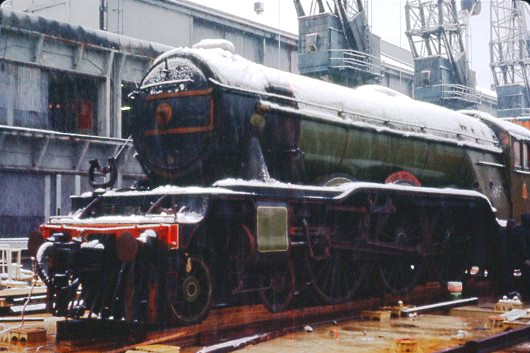
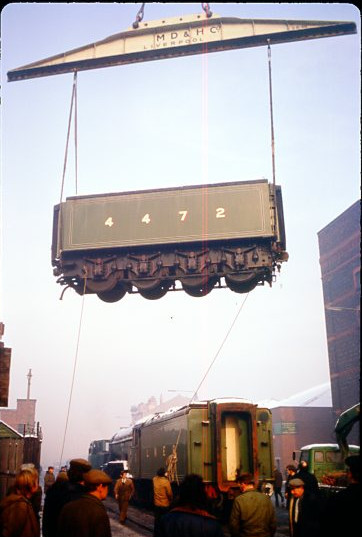
On Thursday 15 February 1973, the 200-ton lift floating crane Mammoth was positioned alongside the California Star in Liverpool’s South Gladstone Dock to unload the 96-ton locomotive and its two tenders. Initially, Flying Scotsman and her tenders were loaded onto Mammoth’s deck and transferred to the East Brocklebank Dock. It was there that locomotive was offloaded onto Mersey Docks & Harbour Board tracks. Once Flying Scotsman had been reunited with her tenders she was towed to Edge Hill Motive Power Depot for a full inspection by BR engineers.
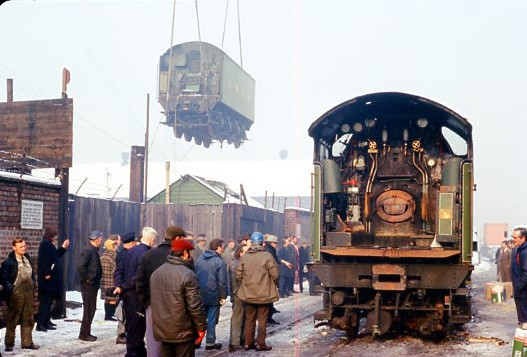
Over the weekend security measures at Edge Hill Motive Power Depot were increased to stop enthusiasts and possible souvenir seekers gaining access. Scotsman underwent a thorough examination. The original plan had been to tow her to Derby Locomotive Works for repainting, but the engineers declared her fit to run under her own steam.
The 100-mile journey from Edge Hill motive power depot to Derby Locomotive Works, was scheduled for Monday 19 February. Apart from a stop at Manchester Victoria, Scotsman would run direct to Derby at a maximum speed of 45 mph. However, a late-running train resulted in the locomotive being signal checked at Earlestown The delay enabled enthusiasts to get up close and personal to one of the finest examples of British engineering. It also enabled a journalist from the Newton Reporter & Guardian to have a quick word with driver George Bernard of Edge Hill MPD. When asked, George replied, “The loco is running really well.”
At Derby Midland station platform 6 was so crowded with people that those not in the know could be forgiven for thinking the Queen or some famous film star or group were about to arrive. But no, it was a weather beaten but mechanically sound steam locomotive.
Flying Scotsman arrived at Derby at 1.43 pm, two minutes ahead of schedule.
For Derby Locomotive Works manager Mr Peter Gray, the Flying Scotsman was an old acquaintance has he had been the Works Manager at Darlington Works in 1964, when the locomotive was overhauled there in readiness for the trip to the United States. It was the design staff at Darlington who produced the drawings for the additional water tender.
As it was, the Friday 23 February, the Derby Evening Telegraph earned a small fortune for Northcliffe Newspapers from the sales of its midday edition. It featured photographs of Flying Scotsman.
–
Featured Image: Flying Scotsman still wearing a cowcatcher and buckeye coupling though it looks likes someone has nicked the bell. (C M Whitehouse/Collection Clive Hardy).

Clive is our Transport and Railway writer, with years of experience he is a fount of knowledge on all things transport nostalgia.