Imagine Britain in the first week of May 1945. Six long, weary years of war had carved lines onto faces and landscapes alike. The air still hung thick with the dust of the Blitz and the scent of austerity. Ration books were a constant companion, dictating the purchase of everything from the morning bacon slice to a new pair of socks. Nights were shrouded in the mandatory blackout, familiar streets transformed into disorienting mazes of shadow, a necessary precaution against the bombers that had claimed over 60,000 civilian lives and shattered countless homes. Anxiety for loved ones serving on distant fronts was a gnawing, ever-present ache. The nation, utterly mobilised for total war, was exhausted.
Yet, amidst the weariness, a palpable buzz filled the spring air. Victory in Europe felt tantalizingly close. Adolf Hitler was dead, his Italian counterpart Mussolini executed. The dreaded wail of the air-raid sirens had finally fallen silent in April. On the coasts, mines and barbed wire were being carefully removed from beaches, silent testaments to a threat that had evaporated. Families huddled around their wireless sets, hanging on every news bulletin. In shop windows, colourful flags and bunting began to appear, cautiously at first, then more boldly. Patriotic scarves, rosettes, and even hair-slides were snapped up in anticipation. For the first time in years, people joined queues not for meagre food rations, but for symbols of hope – a novelty queue, as one observer wryly noted, reflecting a collective will to believe the end was truly nigh.
This anticipation, however, was laced with restlessness. Official confirmation seemed agonizingly slow to arrive. Rumours swirled, hope surged and ebbed, creating a volatile mix of “confusion’, frustration, disbelief and ‘fluctuating emotions'”. People confessed to getting “fed up with the Peace News,” which felt drawn out and indefinite. This complex atmosphere – a blend of desperate hope, profound exhaustion, and simmering impatience – set the stage for an unparalleled explosion of relief and joy when the news finally, irrevocably, broke. The pre-emptive buying of flags wasn’t just preparation; it was an act of faith, a collective assertion of hope against the grim backdrop of prolonged suffering.
“Hostilities Will End Officially…” – The News Breaks
The dam of pent-up emotion finally burst not with a single, coordinated announcement, but in a rolling wave of celebration that began on the evening of Monday, May 7th. Many Britons simply couldn’t wait for the official proclamation. When the BBC interrupted its scheduled programmes late that day with a newsflash – Germany had surrendered unconditionally, the next day, May 8th, would be Victory in Europe Day, a national holiday – the celebrations ignited spontaneously.
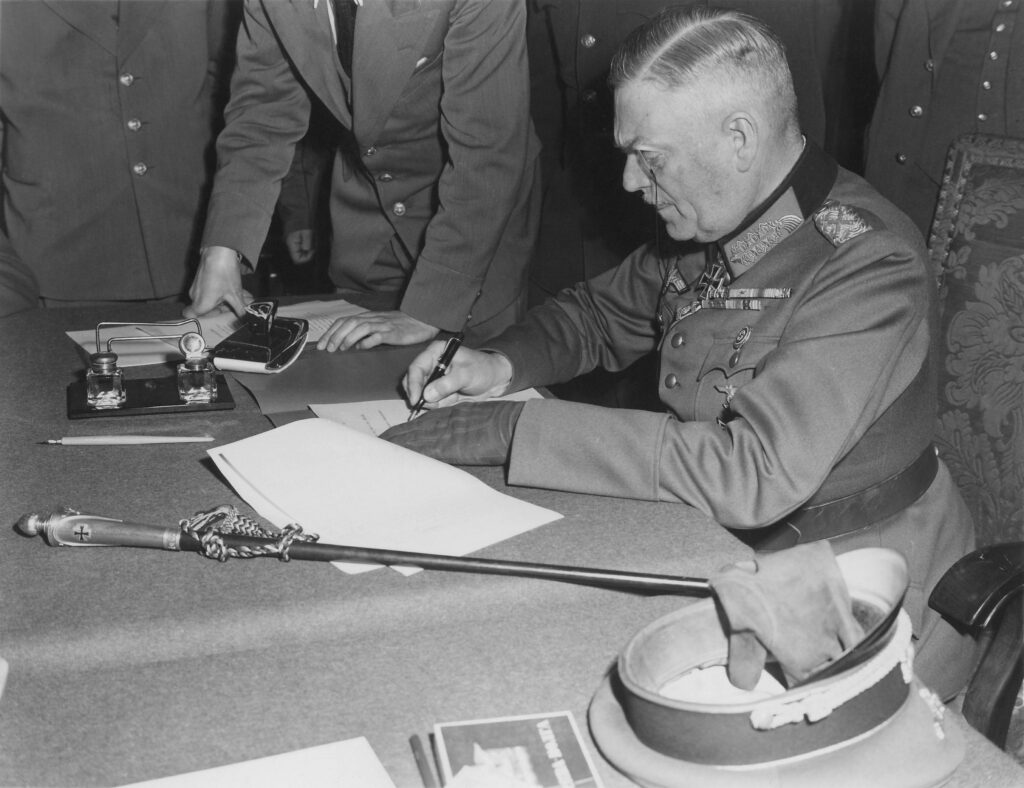
In Cheshire, a diarist working as a typist first heard cheering from the factory floor, followed moments later by an “excited typist” bursting in with the news. In London, another diarist recalled her family’s disbelief at the newsflash, quickly confirmed by the sound of celebratory sirens and hooters from ships docked on the Thames. An Associated Press correspondent, Ed Kennedy, having witnessed the signing ceremony in Reims but bound by an embargo designed to coordinate announcements with the Soviets, felt compelled to file his story after hearing a German radio broadcast announce the surrender – the news was too big to hold back.
Across the country, colourful bunting and flags appeared “as if by magic” on streets starved of colour for years. Bonfires, built in readiness, crackled to life on bomb sites and in town squares. Pubs overflowed with revellers, and impromptu dancing erupted in the streets on the very eve of VE Day. This eagerness, this inability to wait for the official starting gun, reflected the sheer depth of the nation’s yearning for peace. The slightly chaotic, improvised nature of these initial celebrations, after years of wartime regulation and control, spoke volumes about the irrepressible need for release.
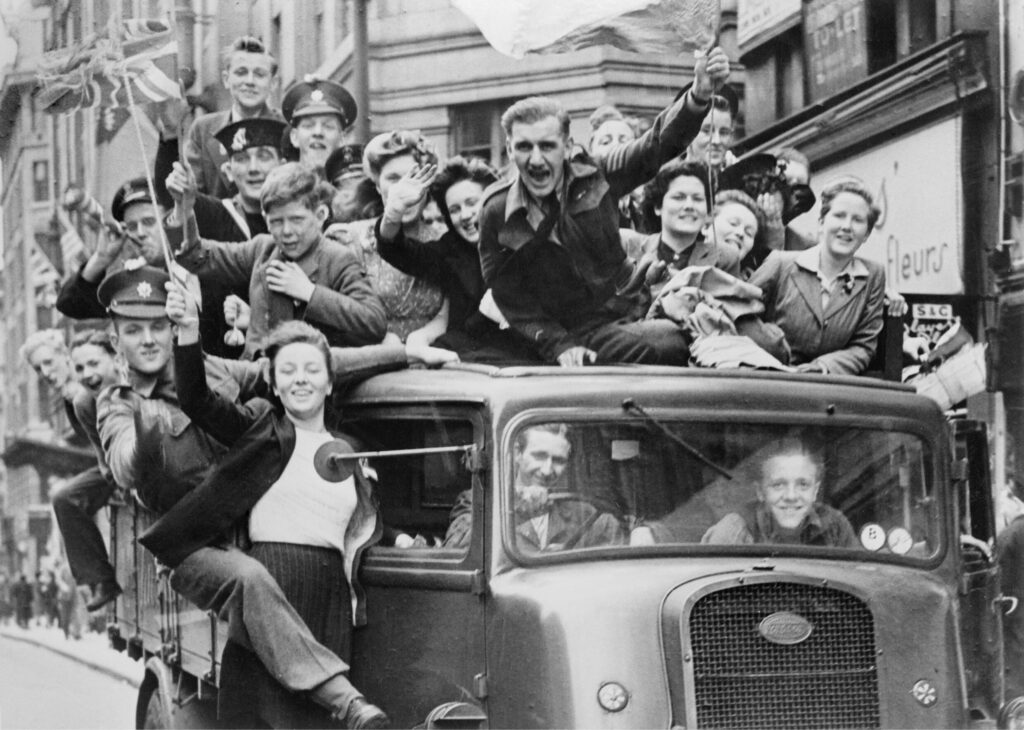
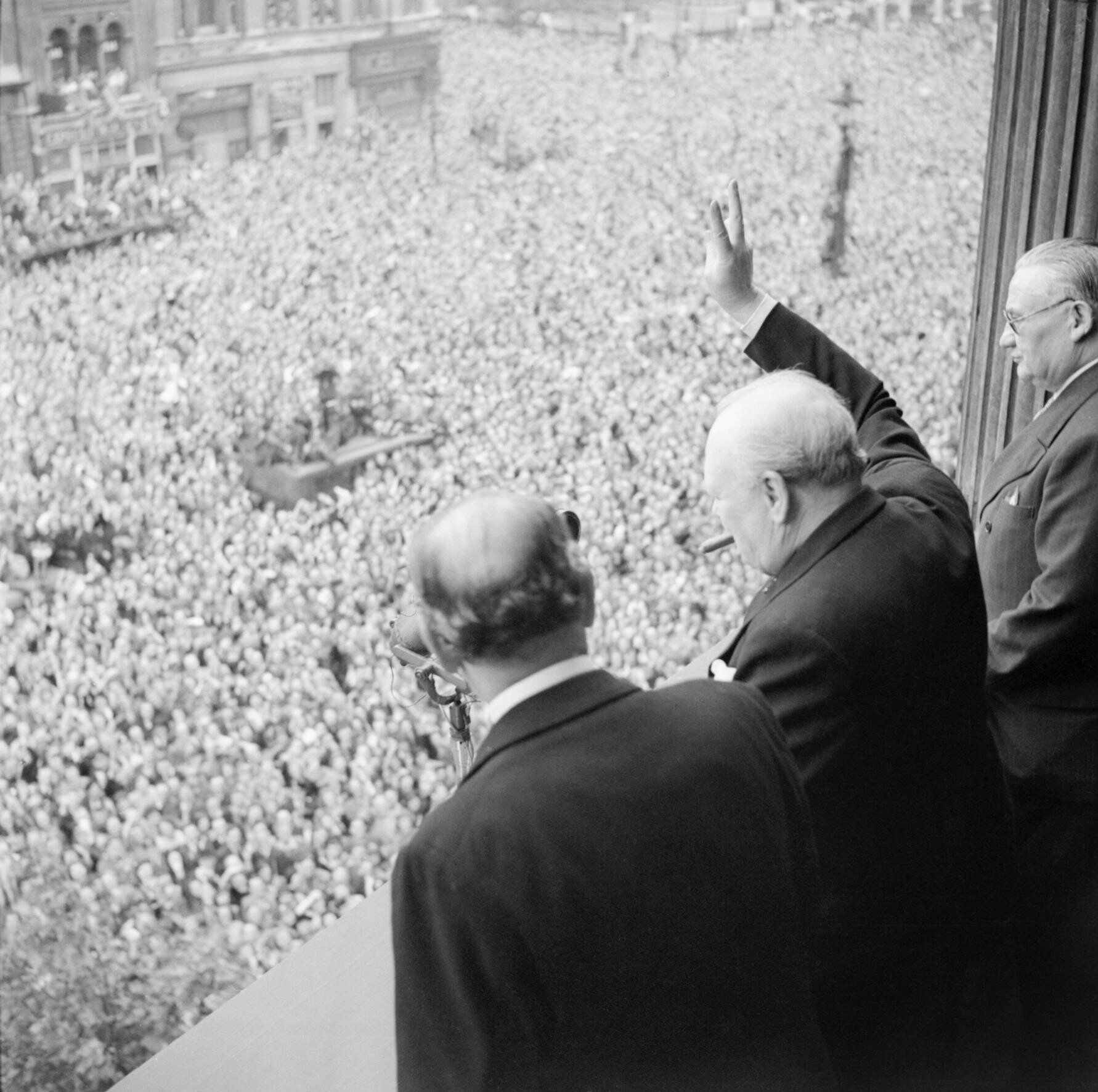
The official confirmation came the following afternoon. At 3 pm on Tuesday, May 8th, the nation fell silent, gathered around crackling wireless sets. Prime Minister Winston Churchill’s unmistakable voice filled the airwaves, confirming the unconditional surrender signed at General Eisenhower’s headquarters in Reims, France. “The German war is therefore at an end,” he declared simply. Yet, even in this moment of triumph, Churchill tempered the joy with a characteristic note of caution: “We may allow ourselves a brief period of rejoicing; but let us not forget for a moment the toil and efforts that lie ahead. Japan, with all her treachery and greed, remains unsubdued”. Later, appearing on the balcony of the Ministry of Health building in Whitehall before a vast, cheering crowd, he famously declared, “This is your victory!” The crowd roared back, “No – it’s yours!”.
That evening, at 9 pm, King George VI added his voice to the national moment, broadcasting to Britain and the Commonwealth. His tone was one of quiet thanksgiving and solemn remembrance. “Let us remember those who will not come back,” he urged, acknowledging the empty chairs at the victory table, “their constancy and courage in battle, their sacrifice and endurance… they are not with us at the moment of our rejoicing”. He praised the “enduring courage and the quiet determination” shown by his people through the long years of war and called on them to face the future and build a lasting peace. His private diary entry for the day captured the shared feeling of relief mixed with apprehension about the future.
These dual messages from the nation’s leaders – celebrating the present victory while acknowledging the ongoing war in the Far East and the challenges of rebuilding – perfectly mirrored the complex reality felt by millions. The official pronouncements validated the public’s euphoria while grounding it in the sober understanding that the struggle was not entirely over, preventing the narrative from becoming one of pure, uncomplicated joy.
Painting the Towns Red, White, and Blue: Street Parties Galore
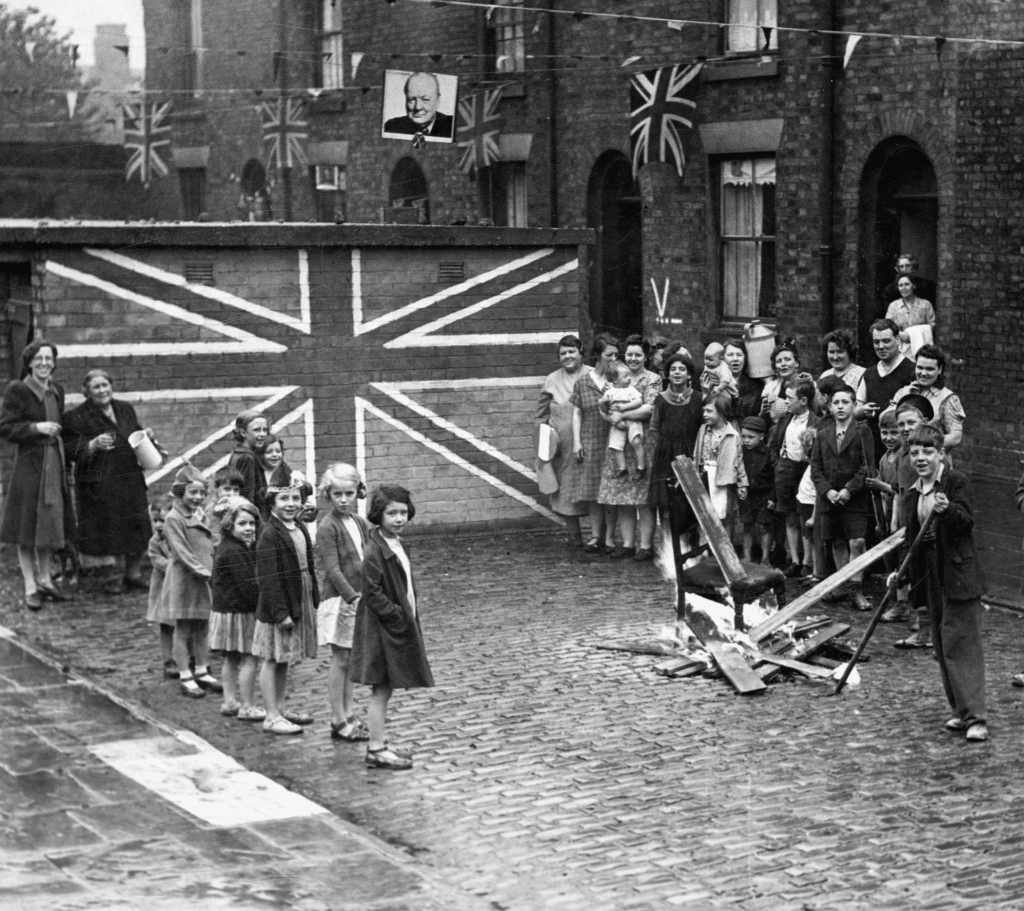
As the official news spread, ordinary streets across the length and breadth of the United Kingdom transformed into extraordinary arenas of celebration. From the terraced rows of industrial cities to the lanes of sleepy villages, neighbours spilled out of their homes, united in relief and ready to party. Trestle tables, rescued from sheds and attics, were lined up end-to-end, groaning under the weight of shared food and drink. Homes and public spaces were festooned with red, white, and blue. Bunting, some perhaps carefully stored since the King’s coronation in 1937 , was strung between windows, draped across bomb sites, and hung from lamp posts. Union Jacks fluttered from seemingly every available surface. From Hampshire Street in Hull and Wolseley Road in Reading to the streets of Caernarfon in Wales , Stoneyburn in Scotland, and countless neighbourhoods in Belfast, the scene was replicated – a spontaneous eruption of communal joy.
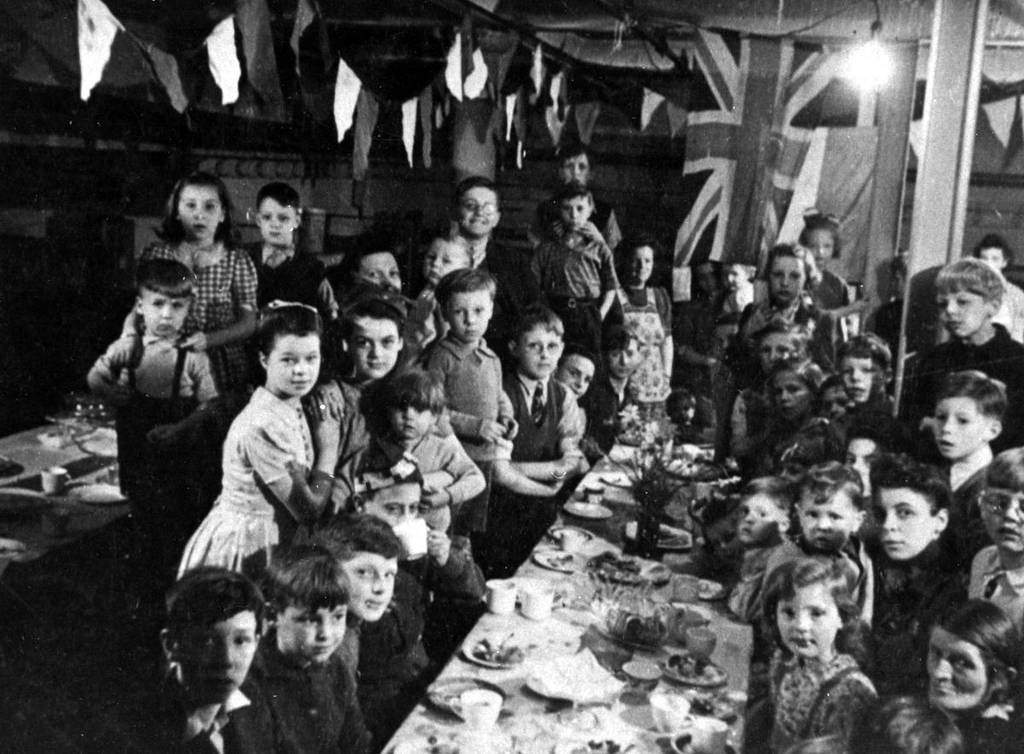
The feasts laid out on those tables were triumphs of resourcefulness over rationing. With strict limits still in place on butter, sugar, meat, and eggs, creating a party spread required ingenuity and cooperation. Neighbours pooled their precious rations, sharing what little they had. The fare was often humble by today’s standards, yet represented a hard-won luxury. Dripping sandwiches (made with beef fat), pork faggots (offal wrapped in fat), and hearty vegetable pies like the famous Lord Woolton Pie or Homity Pie were common savoury options. Sweets were a particular challenge; children were usually allowed only a handful each week. Cakes were often eggless, relying on baking soda and vinegar for lift, or made with grated carrots to eke out the sugar ration. One woman recalled the VE Day party spread of cream sodas, lemonade, and cake as treats the likes of which they’d never had. Another remembered her mother making sandwiches from mashed parsnips flavoured with banana essence in Cardiff. These specific, make-do dishes became culinary symbols of the era’s austerity, making the simple act of sharing them profoundly meaningful. The ability to conjure any kind of feast was a small victory in itself, a testament to the “make do and mend” spirit that had seen the nation through the war.
| Item | Typical Weekly Adult Ration (1945) | VE Day Party Fare Examples |
| Butter/Margarine | 50g Butter, 100g Margarine | Pooled resources, Fat/Lard used in baking |
| Sugar | 225g | Pooled resources, Carrot Cake (less sugar needed), Eggless Cakes |
| Meat/Bacon | ~1s 6d worth Meat, 100g Bacon | Dripping Sandwiches, Pork Faggots, Corned Beef Sandwiches, Lord Woolton Pie (vegetable) |
| Eggs | 1 fresh + 1 dried packet/month | Eggless Cakes, Eggless Mayo |
| Sweets | 350g per month | Rare treat, possibly shared |
| Tea | 50g | Pots of tea shared |
| Fish & Chips | Not Rationed | A potential, less restricted treat |
The air thrummed not just with chatter and laughter, but with music. Church bells, silent for much of the war except to warn of invasion, pealed joyously across the land. Ships in harbour sounded their hooters. Pianos, gramophones, accordions, and even barrel-organs were hauled out onto pavements, providing the soundtrack for spontaneous singing and dancing. Wartime favourites echoed down the streets: Vera Lynn’s poignant ‘We’ll Meet Again’ and ‘(There’ll Be Bluebirds Over) The White Cliffs of Dover’, the cheerful defiance of ‘Run Rabbit Run’, the rousing ‘Land of Hope and Glory’, and the shared Allied/Axis hit ‘Lili Marlene’. People danced jigs, the Lambeth Walk, the Palais Glide, and, ubiquitously, the Conga, which snaked its way through countless streets and squares. In Glasgow, energetic Eightsome Reels broke out spontaneously.
For children, many of whom had known nothing but war, VE Day was an unparalleled adventure. Simple games like pass the parcel, hopscotch, and skipping took over the traffic-free streets. There were egg and spoon races and fancy dress parades. Ten-year-old Joyce Hughes in Liverpool was woken by singing and dancing outside, finding a bonfire blazing and a piano playing in the street, joining the happy, hugging crowds with her parents. Seven-year-old Janet in London marched around her street party, mortified that her mother had made her wear a scarf over her hair curlers. Eight-year-old John Brocklebank remembered neighbours building a huge bonfire to burn an effigy of Hitler, while they ate whatever sandwiches could be scraped together. Lotte Moore recalled neighbours sharing the news, balloons appearing, and eating jelly. The sheer novelty of communal feasting and unrestrained play, after years of scarcity and danger, etched these moments into young memories. However, the reminders of war were never far away; some children, like Margaret Metcalf-Pike in a South Wales village, were genuinely frightened by the effigies of Hitler being burned or hanged.
These street parties were more than just celebrations; they were a powerful, visible reaffirmation of community. After years of being fragmented by evacuation, fractured by bombing, and strained by the pressures of war, neighbours came together in the shared space of their street. The act of pooling scarce resources – a few ounces of sugar here, a length of bunting there, someone’s piano, someone else’s gramophone – became a potent symbol of collective relief and resilience. It was a spontaneous rebuilding of bonds, a reclaiming of communal life in the open air, finally free from the shadow of war.
London Calling: The Epicentre of Elation
While street parties blossomed across the nation, London experienced a celebration on an entirely different scale. The capital became a magnet, drawing in vast throngs not just of Londoners but also people travelling in from surrounding areas like Surrey. Eyewitnesses described an atmosphere akin to a “vast, happy village fete,” but populated by hundreds of thousands, perhaps even a million, people. The sheer concentration of people converging on the iconic landmarks of central London – Buckingham Palace, Whitehall, Trafalgar Square, Piccadilly Circus – transformed the heart of the city into one enormous, swirling, jubilant party.
The scenes captured in photographs and diaries remain legendary. In Trafalgar Square, sailors and their girlfriends splashed in the fountains, while others clambered onto the famous lion statues and even Nelson’s Column. Cabaret performer Carol Hanley recalled emerging from work to find a “seething mass of hundreds of people… dancing, singing, drinking, letting off fireworks” – so intense, she found it terrifying and opted to stay inside. Piccadilly Circus was a vortex of joyous chaos. Crowds swarmed over buses, treating them like temporary viewing platforms. The base of the Eros statue, recently uncovered from its wartime protection, became a stage for impromptu poses and pyramids of celebrating servicemen and women. A journalist caught in the throng reported “dancing the Conga and the jig and ‘Knees up, Mother Brown,’… singing and whistling, and blowing paper trumpets. The idea is to make a noise”. American soldiers were photographed embracing English women amidst the revelry.
Down Whitehall and around Parliament Square, crowds listened to Churchill’s broadcast relayed via loudspeakers and cheered his appearances. Outside Buckingham Palace, the Mall was packed solid, a sea of faces chanting “We want the King! We want the King!”. The sheer scale of these gatherings, focused on the symbolic centres of monarchy and government, gave London’s VE Day a unique character – a national pilgrimage culminating in a collective outpouring of emotion.
The entire city centre seemed alive. When tired, people simply sat down wherever they were – on kerbstones, doorsteps, or the grass of the Royal Parks – watching the human tide flow past or catching a quick nap. Trucks crammed with laughing revellers navigated the streets. Allied servicemen and women from Britain, the Commonwealth, America, and other nations mingled freely with civilians, celebrating together in a spirit of shared victory. The police, usually figures of authority, stood by smiling, tolerant of the exuberant chaos as soldiers swung from lamp posts and bonfires were built from torn-down hoardings. The joy was infectious, breaking down normal reserve, leading strangers to talk, embrace, and dance together.3 Pubs enjoyed extended hours, and dance halls stayed open late. Perhaps most symbolically, after years of enforced darkness, the lights came back on. Buildings like the Houses of Parliament were floodlit, Big Ben’s newly washed face shone, and searchlights crisscrossed the night sky, not in warning, but in celebration. The government decided against sounding the sirens in a final “all clear,” fearing the sound would evoke too many painful memories.
A Royal Night Out
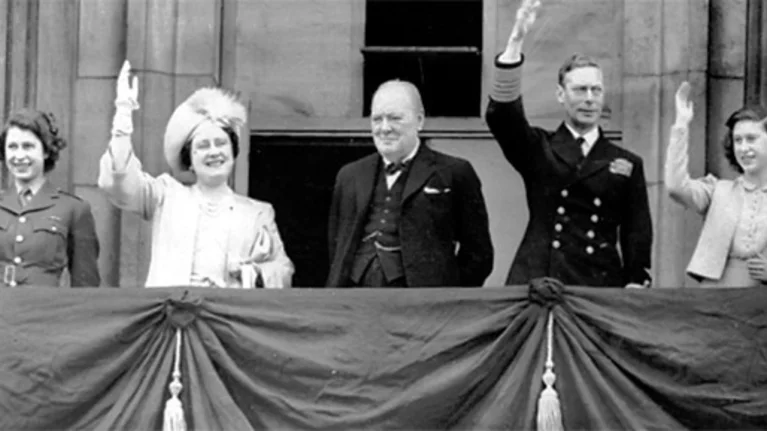
At the absolute heart of the London celebrations stood Buckingham Palace, the focus of the crowd’s affection and anticipation. Throughout VE Day, King George VI, Queen Elizabeth, and their daughters, Princess Elizabeth and Princess Margaret, appeared repeatedly on the palace balcony, waving to the ecstatic sea of people below. They made an unprecedented eight appearances in total, a testament to the crowd’s persistent calls. On one memorable occasion, they were joined by Winston Churchill, a rare break with protocol that perfectly captured the spirit of national unity. Princess Elizabeth, then 19, proudly wore the uniform of the Auxiliary Territorial Service (ATS), in which she had served during the final months of the war.
But the most captivating royal story of VE Day happened away from the balcony’s glare. That evening, eager to experience the celebrations firsthand, Princess Elizabeth and her 14-year-old sister Margaret persuaded their parents to let them slip out of the palace and join the crowds incognito. It was Margaret’s idea, and the King, perhaps reflecting on the restricted lives his daughters had led during the war, agreed, writing in his diary: “Poor darlings, they have never had any fun yet”.
Accompanied by a small group of trusted friends, including Guards officers, the princesses ventured out into the jubilant London night. The Queen later described it as “one of the most memorable nights of my life”. Terrified of being recognised, Elizabeth initially pulled her ATS cap down low over her eyes, only to be gently reprimanded by a Grenadier officer in their party for being improperly dressed. They linked arms with lines of unknown people surging down Whitehall, “swept along on a tide of happiness and relief”. The Queen recalled a comical moment when someone in their party exchanged hats with a Dutch sailor, who then had to trail along with them to get his own hat back.
Their adventure took them through the packed streets and even into the usually staid Ritz hotel. The Queen’s cousin, Margaret Rhodes, who was part of the group, remembered them deciding to “go in the front door of the Ritz and do the conga,” which “rather electrified the stuffy individuals inside”. She doubted anyone realised who they were, likely mistaking them for “just a group of drunk young people”. At one point, the royal party found themselves outside Buckingham Palace with the rest of the crowd, joining in the chants of “We want the King!” They had cheated slightly, the Queen admitted later, by sending a message inside to let their parents know they were waiting, ensuring another balcony appearance.
This secret royal escapade is more than just a charming anecdote. It represents a fleeting, joyous dissolution of the usual barriers – of royal protocol, of class distinction – swallowed up in the overwhelming, unifying euphoria of victory. It allowed the future monarch a precious, unmediated glimpse of her people’s relief and celebration, sharing the historic moment not from a balcony above, but from within the heart of the crowd.
Voices of Victory: A Spectrum of Emotion
While the images of packed streets and waving flags paint a picture of universal joy, the reality of VE Day was a complex tapestry woven with countless individual emotions. For many, the overwhelming feeling was indeed one of pure, unadulterated elation and relief. Patricia Fitzgerald captured this sense of a new dawn: “You suddenly thought that everything was going to be beautiful tomorrow… a lifting you know, you could start to live again”. Samuel King, a Jamaican aircraftsman who would later arrive on the Empire Windrush, recalled being pulled into a pub in Weston-super-Mare and given rum: “Everybody was hopping, jumping about… glad to be alive… It was jolly, jolly, jolly”. Albert Jarrett, another Jamaican in the RAF, stationed near Birmingham, felt “overwhelmed at the joy” and described it as a “marvellous day unlike anything I have experienced since”. Royal Navy sailor Ray Smith simply called his day partying in Trafalgar Square “the best day ever!”.
Yet, for others, the long-awaited day felt strangely muted, even anti-climactic. The typist in Cheshire reported that she and her co-workers felt “sick” and “rather queer” upon first hearing the news. One London diarist found Churchill’s speech “singularly disappointing” and the whole event a “colossal anti-climax,” a sentiment echoed in other accounts, perhaps reflecting the sheer exhaustion after six years of strain, or the difficulty of adjusting to the sudden reality of peace. Another diarist felt the day was surreal, capturing a friend’s bemused comment: “I didn’t imagine we would be spending VE Day this way”.
Amidst the noise and revelry, many experienced the day with quiet reflection, tinged with sadness and grief. Stephen Dale found it “a depressing moment, because I suddenly felt all the awful things that had happened to my family and to me, they came very much to the surface”. Gerald Collis, listening alone to the radio broadcasts of cheering crowds in London, felt “rather alone and quite emotional. In fact I know I wept”. For those who had lost husbands, sons, daughters, or friends – the widows, the bereaved parents, the orphaned children – the jubilant celebrations could be overwhelming. As the King had reminded the nation, many were “not with us at the moment of our rejoicing”. Newspapers reported on quiet thanksgiving services held alongside the street parties, such as the poignant gathering in the ruins of Coventry Cathedral.
Furthermore, the knowledge that the war was not truly over cast a shadow for many. “VE Day you still had the feeling that there was Japan going on and it wasn’t quite over for everybody,” recalled Frances Dunnington-Jefferson. Charlotte Webb, working on codebreaking at Bletchley Park, felt the news was “wonderful” but knew “it made no difference to my work, I was still working towards the efforts in the Far East. Soldiers serving in Europe, like those of The Black Watch, knew their duties continued, guarding strategic points and processing prisoners, while others faced the daunting prospect of redeployment to Asia to fight the Japanese. Young Gladys, evacuated during the war, remembered accusing her sister of lying when told the war was over, acutely aware that fighting continued in the Pacific.
The emotional landscape of VE Day, therefore, was far richer and more nuanced than a simple narrative of celebration allows. It encompassed giddy relief, profound gratitude, quiet tears, lingering anxiety, a sense of anti-climax, and the continued weight of duty. This spectrum of feeling reflects the deeply personal impact of six years of global conflict and the uncertain dawn of the post-war world.
Echoes Through Time: Keepsakes and Memories
Eighty years on, the memories of VE Day 1945 remain vivid, kept alive not only in personal recollections but also through the tangible objects saved from that extraordinary time. Families cherish the faded photographs of neighbours gathered around trestle tables, children in paper hats grinning for the camera. Letters and diaries, penned amidst the excitement and emotion of the day, offer intimate glimpses into individual experiences. Some might still possess a piece of the red, white, and blue bunting that adorned their street, or perhaps one of the commemorative mugs hastily produced to mark the occasion. Initiatives like the ‘Letters to Loved Ones’ campaign continue to uncover and share these precious fragments of the past, connecting present generations with the voices of those who lived through it. The enduring market for VE Day anniversary memorabilia – from pin badges and mugs to collectible coins and tea towels – further attests to the day’s lasting hold on the national imagination.
VE Day was more than just the end of a war in one theatre of conflict. It was a collective exhalation, a moment when a nation, battered but unbowed, paused to embrace the simple, profound joy of survival and the promise of peace. From the grand, symbolic spectacles in the heart of London to the countless humble, heartfelt street parties that blossomed in every corner of the UK, the shared experience forged indelible memories. It was a day of unparalleled community spirit, of resourcefulness born from hardship, and of complex, overlapping emotions. It became a touchstone, a defining moment remembered not just for the victory it marked, but for the resilience and unity of the people who celebrated it. Perhaps no image captures this spirit more poignantly than those of children, waving tiny Union Jacks amidst the bomb-scarred ruins of their homes – a powerful symbol of hope, stubbornly blooming in the wreckage of war, ready to face the uncertain, but finally peaceful, future.
VE Day in Europe
Victory in Europe Day 1945 stands as a unique moment in British history, an explosion of collective relief and joy after six years of devastating conflict, sacrifice, and austerity. The celebrations that swept the United Kingdom were characterised by spontaneity and immense community spirit, manifesting most visibly in the ubiquitous street parties where neighbours pooled scarce resources, shared makeshift feasts symbolic of wartime ingenuity, and danced and sang together in streets suddenly free from the threat of bombs and the gloom of the blackout.
While London served as the epicentre, with vast crowds converging on national landmarks for official announcements and glimpses of the Royal Family, similar scenes of jubilation unfolded in towns and villages across England, Scotland, Wales, and Northern Ireland, each community marking the occasion in its own way, often with bonfires, parades, and local gatherings.
However, the overwhelming emotion of joy was interwoven with a complex spectrum of other feelings. For many, the celebration was tempered by grief for lost loved ones, anxiety for those still serving in the Far East, and a sense of anti-climax or simple exhaustion after the prolonged strain of war. The official messages from Churchill and King George VI acknowledged this duality, balancing triumphant rhetoric with calls for remembrance and reminders of the tasks still ahead.
The enduring legacy of VE Day lies not only in the historical fact of Germany’s surrender but in the powerful collective memory it created – a memory of shared hardship overcome, of national unity, resilience, and the profound, longed-for return of peace to Europe. The stories, photographs, and keepsakes passed down through generations ensure that the spirit of that extraordinary day continues to resonate.

Andy is the Editor of iNostalgia and is a regular contributor to our exploring history & nostalgia articles, with a love for community nostalgia.